On Sunday, 20th April the seniors advocacy organization CCRP (Caribbean Community of Retired Persons) will celebrate our 15th Anniversary. After the 30th Anniversary of our company, PROComm in 2009, I considered who had helped me along my journey and realized they were seniors including my Mother Maisie Lowrie who was our first investor and supported us throughout the years. In gratitude, I decided that I would start an organization to advocate for our underserved seniors.
Our initial collaborators were my husband Hubie Chin, Ambassador Aloun Assamba who donated all the legal work, registering the organization and preparing our Articles of Incorporation; J. Lester Spaulding, late Chair of the RJR Gleaner Group who set up our accounting system, Professor Sir Kenneth Hall, our Honorary Director and Professor Denise Eldemire Shearer, our Honorary Chair. We thank our Patron Governor General Sir Patrick Allen and Lady Allen for hosting our first media event at which the late Hon Oliver Clarke registered to be our first member – now we are over 12,000 members strong.
We are blessed with excellent Board Directors: Vilma McDonald, Director Emerita Ambassador Aloun Assamba, Patricia Reid-Waugh, Marlene Street Forrest, Dr Owen James, Dennis Jones, Sethuraman Kumaraswamy, Warren McDonald, Peter Mais and Donovan Wignal. We recently appointed Angela Patterson as our General Manager, supported by the PROComm Team.
CCRP’s voluntary regional convenors are Patricia Blackwood – Central Jamaica; Dr Norma Taylor – Western Jamaica; and Pixley Irons, Northeast Jamaica. Our Caring Committee Chair is Moveta Munroe; former chairs are Irene Walter and Verla Seymour. The Committee comprises our parish representatives, who assist in our outreach to the needy elderly. Our excursions planned by Charmaine Harrison are hugely popular – they help our members in the words of our motto to live ‘Life to the Fullest’.
We thank our over 100 discount partners and top sponsors JNGI, National Baking, BPM Financial, Juici Jamaica, Supreme Ventures, Cari-Med Group, Sandals Group, Sterling Asset Management, WIHCON, Sagicor, Gallagher Insurance Brokers, managers of CCRP health plans and Morgan White Insurance.
We congratulate Senator Floyd Morris and Senator Sherene Golding-Campbell for taking the Motion for Legislation for the Care and Protection of the Elderly to an active Special Select Committee of Parliament which has been holding hearings on the matter. CCRP has made a comprehensive submission to the Committee, and we are optimistic that this Legislation will soon become a reality.
Former Chief Executive Officer of the Jamaica Information Service, Enthrose Campbell, at a recent farewell ceremony held at the agency’s head offices in Kingston.
The Jamaica Information Service (JIS) family bade farewell to former Chief Executive Officer (CEO), Enthrose Campbell, who retired on December 31, 2024.
Team members gathered at the agency’s head office on Half-Way Tree Road in Kingston recently, to celebrate the respected journalist and dedicated civil servant, who spent almost 30 years at the Government’s news agency, serving as CEO for the last two years.
Campbell’s illustrious career stands as a testament to dedicated public service and transformative leadership in government communication.
“It was a really good 29 years,” she said, reflecting on her time at the agency.
“It was good for me because I moved from radio to TV to production to deputy CEO and then to CEO. It was a good experience.
“I am really delighted to have worked with all of you. It has been a journey and I am grateful and thankful. Thank you for your support, you made my work so easy… because you all did so well,” she added.
Campbell commenced her tenure at the JIS as a temporary editor in 1995, rising through the ranks and making impactful contributions before being ultimately appointed to head the agency in October 2023.
Among her notable appointments was as senior editor and radio manager, where she played a pivotal role in modernising broadcast operations, and as director of electronic productions, where she oversaw the agency’s multimedia content strategy. As deputy CEO, she was instrumental in driving the agency’s digital transformation.
Campbell’s exceptional leadership was exemplified by herskilful media management of critical national events, including State visits and disaster-response efforts.
Another of Campbell’s key achievements was transforming the agency’s ‘Get the Facts’ television programme into Jamaica’s premier platform for articulating Government policies and programmes, which, at its peak, directly reached more than 300,000 weekly viewers.
Notably, she spearheaded the establishment of the JIS Morant Bay Regional Office in St Thomas in 2023 to enhance community outreach.
Beyond her roles at the JIS, Campbell made significant contributions to public service, particularly through diplomatic translation.Leveraging her master’s degree in Spanish translation, she provided critical interpretation services for numerous international summits, State visits and CARICOM delegations at United Nations assemblies.
Throughout her illustrious career, Campbell pursued specialised training across five continents, honing her skills in media management, disaster communications and digital journalism.
Her impact and excellence were widely recognised through myriad accolades and awards. These include the prestigious 2019 Press Association of Jamaica Veterans Award, the 2013 Civil Servant of the Year Award, and annual commendations for crisis communications leadership from successive Cabinet Secretaries between 2005 and 2016.
Aside from her professional achievements, Campbell dedicated 25 years to volunteering as a Sunday school teacher, positively impacting more than 1,500 children through youth programmes.
Acting Chief Executive Officer of the JIS, Celia Lindsay, commended Campbell for her impactful leadership.
“[You] never faltered in providing strong and visionary leadership through the celebrations as well as the challenges, ensuring that optimum levels of performance would have been maintained,” she shared.
“Ms Campbell, your leadership of the Jamaica InformationService and your many years of dedicated contribution have been sterling and a source of inspiration to many of us. Thank you for being a remarkable leader; your legacy will continue to motivate us.”
Manager for the JIS Radio Department, Vaughn Davis, noted that Campbell was an instrumental part of his entry into radio production.
Davis joined the JIS as a research officer in the Research and Publications Department in 2009 and made the switch to radio three years later.
Despite having no prior experience in radio production, Davis seized the opportunity and, 15 years later, credits Campbell for her unwavering support in shaping his success.
“Throughout my time in Radio, Ms Campbell had always been very supportive and had words of encouragement and advice to help me grow and develop,” he said.
He noted that “she has always been a source of good professional and personal advice, and her cheerful and pleasant disposition has also been much appreciated. I wish her well in her retirement and hope she finds happiness and fulfilment in her second act.”
Managing Editor of the Editorial and Photography Department, Tracey Chin Loy, described Campbell as “both a mentor and a friend”. “I will always treasure our one-on-one sessions. Her support and guidance have made me a stronger and more confident leader,” she shared.
Chin Loy noted that the former CEO’s ability to inspire team collaboration, combined with the positive energy she brought to the workplace, “will be missed”.
“She can feel confident that she has left a legacy of outstanding achievement that will inspire everyone she worked with,” the managing editor added.
Senior audiovisual librarian, Simone Burnside, noted that “Ms Campbell has an impeccable sense of style that is commendable”.
Her legacy lives on through the JIS’s expanded regional presence and the new generation of media professionals shementored, she said.
Campbell’s unwavering dedication, exceptional leadership and profound impact on Jamaica’s communication landscape have left an indelible mark on the nation, its people and the field of public service.
Kavelle Hylton, Digicel Foundation SIT programme partner and CEO of STEM Builders Learning Hub, engages students at the Jessie Ripoll Primary School in interactive discussions on online safety.
The Digicel Foundation’s Safer Internet Together (SIT) programme has already impacted more than 5,000 students across Jamaica, equipping them with the knowledge to navigate the digital world safely and responsibly.
Launched on Safer Internet Day in February, the programme is now in its fifth week and has visited 20 primary and high schools, with a goal of reaching 150 schools by year-end. Kavelle Hylton, CEO of STEM Builders Learning Hub, who partners with Digicel Foundation to deliver the interactive lessons, highlighted the programme’s impact: “Technology is a powerful tool, but it must be used responsibly. Through the SIT programme, we are empowering not just students, but also parents, teachers, and community members with the skills they need to stay safe online.”
A dedicated volunteer team of nearly 200 Digicel employees, known as the SIT Squad, has been mobilised to support the initiative.Mona Heights Primary School Principal Alex Hepburn is among those commending Digicel Foundation for the initiative.
“The SIT programme has been invaluable in helping our students understand online safety. We want them to understand that there are certain nuisances in the online space and therefore it is very important to teach them how to navigate it responsibly,” said Hepburn.In the meantime St Jude’s Primary School Principal Susanna Ainsworth also expressed support for the programme.
“This initiative has empowered our students and staff to promote online safety, digital responsibility, and cyber awareness. We are thankful for the Digicel Foundation for its dedication to creating a safer online environment for our school community,” said Ainsworth.
The SIT programme is a holistic awareness and educational campaign that goes beyond the classroom.
In addition to engaging students, the initiative includes sessions for parents and teachers, helping them understand online risks and how to guide children in safe internet usage.
It also extends to business owners, service group members and the elderly, ensuring that digital literacy and cybersecurity awareness reach all generations.
The success of the SIT programme to date can be attributed in large part to the support of its partners, including Jamaica Public Service Company, Sunshine Snacks, Kool 97FM, and Macmillan Education.
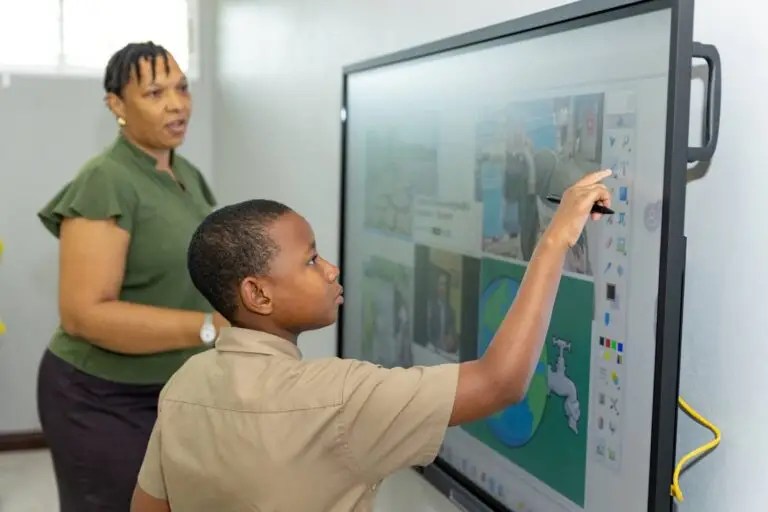
Deputy head boy of Santa Cruz Primary School Kemar Smith (right) explores the possibilities of the new smart lab, a cutting-edge space designed to enhance digital literacy as his teacher Kamala McKnight guides him.
THE Digicel Foundation has officially opened a state-of-the-art smart lab at Santa Cruz Primary School in St Elizabeth.
This innovative learning space is designed to bridge the digital divide and expose students to 21st-century skills and job opportunities.Charmaine Daniels, CEO of the Digicel Foundation, shared that while Santa Cruz Primary is the first school in St Elizabeth to receive a smart lab, it will not be the last.
“In a few days from now we will be right down the road at the Black River Primary School opening another smart lab and ensuring that even more students in St Elizabeth have access to cutting-edge technology and digital learning tools,” said Daniels.She shared that the lab will also serve as a hub for the foundation’s recently launched Safer Internet Together (SIT) programme, which aims to promote online safety and digital citizenship.
“As we introduce advanced digital technology in schools, it’s essential that we also educate our youths on how to use it safely and responsibly. That’s why we’ve proudly launched our SIT programme, a year-long initiative which will empower students, parents, and educators to navigate the online world confidently,” added Daniels.Senior education officer in the Ministry of Education, Youth, Skills and Information’s Region 5, Nevadeene Gallimore Miller, urged parents to continue learning beyond the smart lab.
“We want parents to assist us in ensuring that ICT [information and communication technology] penetration does not stop at the school gate. We want when your children come home with the information and the ideas that they would have been engaged in at school, that you support them,” said Gallimore Miller.
By the end of March 2025 there will be 21 smart labs established by Digicel Foundation.
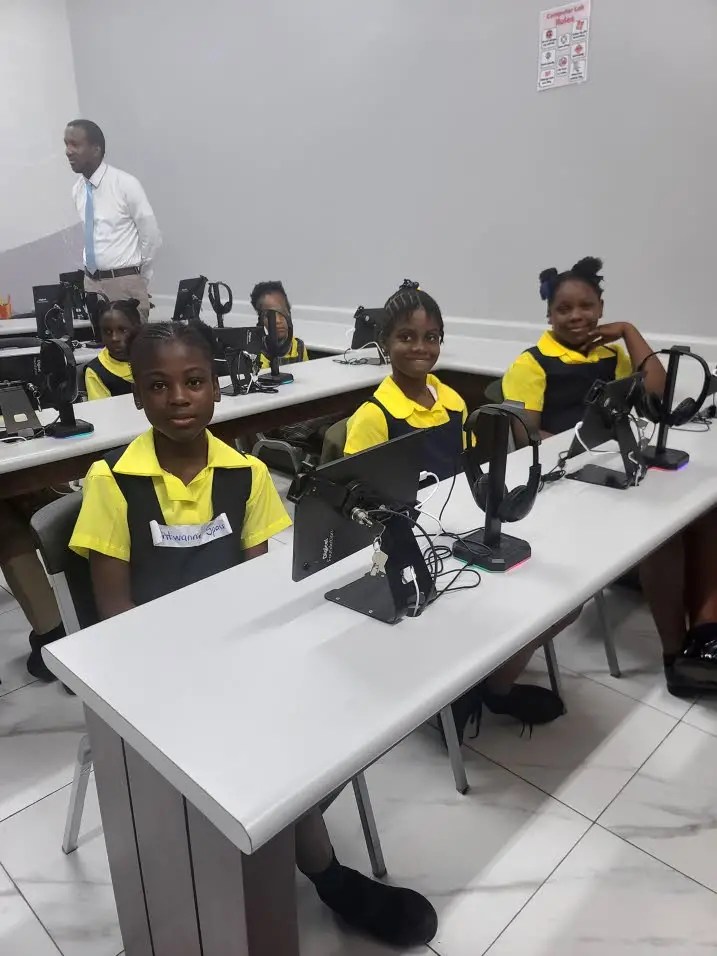
Each lab costs approximately US$70,000 and is equipped with 12 laptops, 12 tablets, a printer, a smart door lock, and an interactive mimio-compatible smart board.
Since inception, Digicel Foundation has spent over US$2.5 million on projects in St Elizabeth. In 2023 the foundation opened the Santa Cruz Special Education Centre, a space dedicated to providing quality education and support for students with special needs in the parish.
Deborah Broomfield, construction project manager at the Digicel Foundation, engages with students at Santa Cruz Primary School inside their newly opened smart lab, which is set to transform learning experiences, equipping students with essential digital skills for the future.
Students from Mustard Seed Communities Mary’s Child (in white) learn about the fundamentals of robots in a coding session with Darren Fletcher, Technical Project Coordinator at Mona Geoinformatics Institute (MGI) while Luke Buchanan (left), MGI Executive Director, Debbie Green (centre), IGT General Manager and Kevin Johnson (right), MGI Software Developer watch attentively. This year’s staging of the Coding and Robotics Rock! Camp is hosted by IGT in collaboration with MGI. The virtual camp ran from July 15 – 26 with 72 participants from five Caribbean countries: Jamaica, Barbados, St. Kitts and Nevis, Trinidad and Tobago, St. Maarten. This is the fourth edition of the annual camp. (Photo: Contributed)
International Game Technology (IGT), a global leader in gaming technology and innovation, is pleased to announce the successful completion of its fourth annual IGT Coding and Robotics Rock! Camp for Caribbean youth, held July 15-26.
IGT partnered with the Mona Geoinformatics Institute (MGI) to host the virtual camp, under the theme “Climate Action.”
The camp serves as an extension of IGT’s global After School Advantage programme.
Debbie Green, general manager of IGT Jamaica, delivered remarks at the start of the camp, underscoring IGT’s commitment to digital learning and community empowerment.
“As part of IGT’s Sustainable Play programme, our After School Advantage initiative is devoted to providing youth with access to technology and promoting digital learning opportunities in the communities where IGToperates. This camp is a shining example of our commitment to these goals,” said Green.
Since its inception in 2021, this regional tech learning camp has seen remarkable growth. What began as a pilot programme for 36 participants across five countries has flourished into a signature IGT ASA project, significantly impacting our communities.
In 2022, the camp expanded to include a Level II component, increasing the cohort to 72 students at both the Introductory (Level I) and Intermediate (Level II) levels. Hundreds of Caribbean youth have gained valuable knowledge in coding and robotics through this camp.
This year, students participated from Jamaica, Trinidad and Tobago, St. Kitts and Nevis, Barbados, and St.Maarten.
Jamaican participants hailed from Mustard Seed Communities – Matthew 25:40, Mary’s Child, and Jerusalem; Spring Village Development Foundation; and the Women’s Centre of Jamaica Foundation in Mandeville and Savanna-la-mar. Barbados participants were from The Learning Centre and the Rupert I. Maynard Youth Community Centre; St. Maarten – St. Maarten Youth Council; Trinidad and Tobago – Sophia House, Cotton Tree Foundation, Amica House and Credo Boys; and St Kitts and Nevis – Maude Crosse Preparatory School.
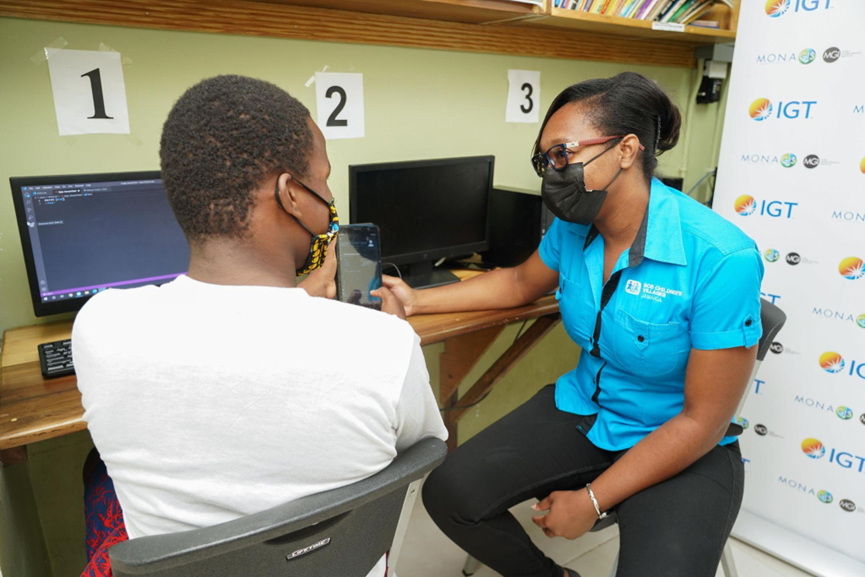
This young man shared his progress from the day’s coding and robotics activity with Hilary Nembhard of SOS Children’s Village Jamaica’s Stony Hill location during the 2023 Coding and Robotics Rock! Camp. (Photo: Contributed)
The Level I course introduced students to the fascinating world of computer science, providing a foundational understanding of coding and computing, exploring careers in the industry, and developing essential skills such as website development and robotics.
Specifically, the Level I course aimed to:
Build awareness of coding and its applications.
Inform about potential careers for developers.
Develop basic computing and development literacy.
Teach the basics of computer programming.
Introduce website development.
Explore robotics.
Enhance problem-solving skills
For returning students in Level II, this year’s programme built upon the knowledge gained last summer, with afocus on more complex web development, including HTML, CSS, and JavaScript, and an introduction to artificial intelligence.
The Level II course aimed to:
Provide a refresher on last year’s content.
Improve website development skills with advanced techniques.
Introduce the principles of artificial intelligence.
Further develop problem-solving skills.
An exciting new feature of this year’s camp was the provision for the intermediate robotics class to develop hands-on robot creation.
Green encouraged students to embrace this learning adventure with enthusiasm and curiosity.
“The skills you acquire here will not only open doors to exciting career opportunities but also equip you to become innovators and problem-solvers in our ever-evolving digital world,” she said.
Green also extended heartfelt thanks to partners at MGI and the UWI team for their unwavering support and collaboration in making this camp a success.
“Your dedication to nurturing young minds and fostering technological skills is truly commendable,” she added.
Last Friday we gathered at the former Foundation for International Self-Help Jamaica Limited (FISH) Clinic to celebrate the 40th anniversary of the renamed Louis Grant Medical Centre in honour of its founder, Professor Grant. The beloved professor created the clinic in 1975 at 19 Gordon Town Road, near Papine, to serve less fortunate Jamaicans.
In her tribute at the event, his daughter, Bette Grant Otunla, traced the humble beginnings of this son of Mitchell Town, Clarendon, whose love of learning gained him the Vere Trust Scholarship to Jamaica College at a time when the College was a school for the privileged. The outstanding student was recommended by his headmaster, William Cowper, to take up a position at the government laboratory. This involved working visits to the Kingston Public Hospital where young Grant became interested in medicine, and with his savings and assistance from his family, enrolled at University of Edinburgh.
“He graduated in 1939 with his medical degree, three months before World War II started, and returned to the government laboratory in Jamaica,” shared his daughter. Soon after “he was awarded a Rockefeller Foundation scholarship to do a master’s in public health at the University of Michigan in the USA, which then had one of the best public health programmes in the world … [He] set up an excellent system of laboratory services in Jamaica on his return,” she said. This continues to be a linchpin of Jamaica’s health system.
Professor Grant was one of the first members of staff at the newly established The University College of the West Indies (UCWI) and was awarded a scholarship to study bacteriology at London School of Tropical Medicine and Hygiene. Thus armed, he set up the Department of Bacteriology at The UCWI. His research on tropical diseases led him to appeal to the World Health Organization and UNICEF to provide vaccines for an islandwide immunisation operation. We can thank the goodly professor for the eradication of tuberculosis in Jamaica.
Further, he noted the suffering of patients with leptospirosis and embarked on a public education campaign so Jamaicans would learn to protect themselves from rats, which carried this often-fatal disease. When equine encephalitis became widespread among horses, Professor Grant set up an area for animals near the Mona Post Office where he could test and treat them.
The professor used his knowledge to help protect Jamaica’s livestock. One of his colleagues at the Department of Bacteriology, Dr Owen James, recalled, “Outside of the department in nearby communities like August Town or further afield in St Thomas, chickens or goats or horses or other animals would be kept in certain areas and checked from time to time. This could signal a warning of an imminent outbreak of a particular disease, based on the findings from these ‘Sentinel stations’.”
On Tuesday, February 11, 2025 the Digicel Foundation launched their ‘Safer Internet Together’ (SIT) programme at The UWI, Mona. The programme, which was launched on Safer Internet Day 2025, targets STEM programmes at over 150 educational institutions. From left: Avryl Francis, Security Operations Manager, Digicel; Antoinette Heirs, Digicel Foundation Board Director; Dr Terri-Karelle Reid, Founder of Open Door Jamaica Foundation; Charmaine Daniels, Digicel Foundation CEO; and Joy Clark, Board Chair of Digicel Foundation.
The internet offers a world of possibilities, providing benefits and opportunities. It has made everyday life more convenient and knowledge more accessible. However, the online world is far from perfect. It has become a confusing, complex space for many Jamaicans to navigate. At times, the internet can seem like an unsafe place to be.
What are the dangers lurking in the digital landscape – and how can we protect ourselves? Addressing these concerns, the Digicel Foundation officially launched its Safer Internet Together (SIT) Programme on Tuesday, February 11, 2025. This year-long initiative puts the emphasis on online safety, digital responsibility and cyber awareness – for all Jamaicans.
The launch event at the Mona School of Business and Management, University of the West Indies (UWI), Mona, observed Safer Internet Day 2025, under the theme “Together, For A Better Internet.” Digicel Foundation will roll out the SIT initiative in 150 educational institutions, in partnership with the ministry of Education, Skills, Youth and Information, STEM Builders Learning Hub, United Nations Children’s Fund (UNICEF), Sunshine Snacks, Jamaica Public Service Company (JPS), and MacMillan Education.
As CEO of Digicel Foundation Charmaine Daniels pointed out [in a Letter to the Editor] the programme of activities will be inclusive, “engaging diverse groups across the country on digital literacy and online responsibility.” Daniels added: “Furthermore, in partnership with the Caribbean Community of Retired Persons (CCRP), we will conduct specialised sessions during Senior Citizens’ Month in September to help older adults recognise and protect themselves against online threats.”
Marcelo Cataldo, CEO of the Digicel Group explained the programme’s goal: “We work every day to have our Internet available to our customers, but we are also mindful of the potential risks that the internet poses for young children. With the Safer Internet Together programme, we intend to raise awareness on how to mitigate the space carefully, with the help of all our sponsors.”
“Our responsibility at Digicel is to work together to help the new generation to be safe and to be protected.”
Assistant Commissioner of Police in charge of Technology, Leonardo Brown, in a dynamic presentation at the launch, reminded participants: “The internet and connectivity never forgets; whatever you post remains somewhere.”
Audience member Christoph Tucker reacted: “This day provides opportunities to learn about online risks, how to stay safe online, where to get help, and how to gain a better understanding of the laws.” He stressed: “There are so many young children nowadays using tablets. We want to ensure that they’re always safe and exposed to the right content, so that they become good people within our society.”
The Digicel Foundation CEO urged stakeholders and Jamaicans, young and old: “As we observe Safer Internet Day, let us commit to making the internet a place of opportunity rather than a source of harm. Let us foster a culture of responsible digital citizenship, ensuring that everyone – regardless of age or background – can explore the online world safely and confidently.”
A young girl beams with joy while enjoying the see-saw with the support of Digicel Foundation CEO Charmaine Daniels at the Early Stimulation Plus Development Centre in Kingston on Wednesday.
DIGICEL Foundation made ‘Play Day’ extra special for the children at the Early Stimulation Plus Development Centre in Rockfort, Kingston, by spending a morning engaging in games and fun activities.
February has been designated as Play Month by the Early Childhood Commission (ECC), a celebration endorsed by the United Nations Children’s Fund (UNICEF) Jamaica Office.This year’s theme, ‘Bringing Back the Game of Play Through Traditional Games — Out of Many, One People,’ highlights the importance of play in early childhood development while embracing Jamaica’s rich cultural heritage.
During the visit, Digicel Foundation staff and board members joined the children in classic Jamaican games such as dandy shandy and hopscotch.In addition to the interactive play activities, the Digicel Foundation also donated crayons and colouring books to the school, providing the students with creative resources to support their learning and development.
Charmaine Daniels, CEO of Digicel Foundation, emphasised the significance of supporting institutions like the Early Stimulation Plus Development Centre.“The Early Stimulation Plus Development Centre is dear to us, as it is one of the 21 special needs schools we renovated a few years ago. Play is an essential part of childhood development, and we are delighted to be part of this initiative that brings joy, inclusion, and learning to these children,” said Daniels.
She pointed out that the Digicel Foundation has been a longstanding advocate for children with disabilities, investing over US$11.8 million in special needs initiatives across Jamaica since inception.
Amira Anderson of Mountain View Primary and Infant School interacts with the Coldax Smart touchscreen device donated by Digicel Foundation. Looking on from left are Mountain View Primary Principal Michelle Robinson, student Steve Richards, senior operations manager at Digicel Foundation Jodi-Ann McFarlene; and Leanne Spence, product training and development manager at Coldax Smart. Occasion was the official handing over ceremony of a smart lab by Digicel Foundation to Mountain View Primary and Infant School on Wednesday. (Photo: Naphtali Junior)
With Mountain View Primary and Infant School becoming the 12th school to receive a new smart lab from the Digicel Foundation, permanent secretary at the Ministry of Education Dr Kasan Troupe is urging teachers to maximise the use of technology in schools and give students more opportunities to engage with the devices.
“Teachers, do not be afraid of it. It is for use, for learning, for exploring,” she said at the handing-over ceremony of a smart lab on Wednesday at the Mountain View Primary and Infant School.
Dr Troupe expressed disappointment that, based on her observations, some schools have not been making full use of these devices mainly due to the fear of students damaging them. However, she is urging teachers to take a different approach by spending more time training students to use the devices instead of locking them away.
“I have had the opportunity to go into some schools and see the labs closed because teachers are fearful that the students will damage the equipment. We just need to train the students how to utilise the devices. But do not lock it away from the children. Please give them access, please excite them as they continue to champion their future with the support of the Digicel Foundation, the Ministry of Education, and the families who continue to partner in education,” she urged.
Dr Troupe used the opportunity to laud the Digicel Foundation for its support and commitment, especially with the challenges still affecting the education sector.
“Whenever you invest in education you invest in the future of our country and the Digicel Foundation has always been with us. When COVID came, we knew not what to do and we had our students with special needs who were at a disadvantage because they were out of the space, and the Digicel Foundation was the first entity to partner with the Ministry of Education to make sure that there was access to our students with special needs,” she saidAdditionally, enrichment programme specialist at the Ministry of Education Shauner Murray echoed Dr Troupe’s sentiments, emphasising the need to prioritise sustainability to ensure long-term durability of the devices.
“There ought to be a way to help stakeholders to understand the value of what they have so that after the initial planting of these seeds, these ventures can be sustained. Sustainability has to be a key aspect of our understanding. Sustainability is critical so that this immeasurable value will not just serve those who are current, but will serve those who are to come, especially the younger children entering grade one,” said Murray.
She urged parents, teachers and other representatives in the Ministry of Education to protect these investments and maximise their potential.
In the meantime, board chairman at the Mountain View Primary and Infant School Howard Chamberlain Jr expressed gratitude for the Digicel Foundation’s contribution, noting that the smart lab will have a positive impact on student performance at the school, especially in the Primary Exit Profile (PEP).
He said the lab will play a major role in bridging the digital divide among students at the school.
“We are placed in an area, in a community where the majority of the students that come to us are at-risk [and] majority of the students that come to us are from low-income families, and as such our role and our job is very important to ensure that we guide them on a path that they can further enrich their lives and develop their communities,” he said.
The lab, he added, is an important step for students and teachers to embrace the importance of involving more technology in schools.
“This smart lab comes at an important time where we are pivoting or shifting our focus to see how best we can push the use of technology in education here at Mountain View; we hear about AI coming up, kids using phones, and stuff like that, and we are having this tug-of-war with them, to push them to the sort of book and pencil that we grew up on, but the truth of the matter is that this generation has changed. They are far ahead of us and some of these technology and these intellectual programmes, we have to embrace them and find ways to include them in education,” he said.
The smart lab is outfitted with laptops, tablets and a smart board that will be used to facilitate teaching and learning at the school.
The Digicel Foundation smart labs project is an initiative aimed at equipping 21 schools across Jamaica with technology to enhance learning and bridging the digital divide in schools.
From Right: Charmaine Daniels, CEO of Digicel Foundation little girls- Salt Spring Primary students – Rickayla Warlock and Ty’aira Young; Boys in picture : Kaneil Whilby and Raveesh Brown, Students of Prickly Pole Primary & Infant School; Lady in Red – Judith Whyte Gayle, Principal, Prickly Pole Primary & Infant School; Lady in Black : Norma Brydson – Principal Salt Spring Primary & Infant School
Community groups across Jamaica are invited to apply for the Digicel Foundation’s 20 for 20 for 20 Grants.
The grants which are in celebration of the Foundation’s 20th anniversary, will run until August 30, 2024. Registered non-profit organisations, including community-based organisations, special needs organisations, social enterprises, and schools, can apply for grant funding of up to US$20,000 to implement community initiatives that focus on one of the following subject areas: youth development; ICT development; environmental sustainability; Special Needs support and education.
“We are happy to celebrate this milestone anniversary by giving back to the communities we serve,” said Miguel ‘Steppa’ Williams, Director of Strategy and Community Development at the Digicel Foundation. “Our 20 for 20 for 20 Grants will empower local organisations to drive meaningful change and create lasting impact.”











 Jamaica Highlights