IGT hosts 4th Coding and Robotics Rock! camp

Students from Mustard Seed Communities Mary’s Child (in white) learn about the fundamentals of robots in a coding session with Darren Fletcher, Technical Project Coordinator at Mona Geoinformatics Institute (MGI) while Luke Buchanan (left), MGI Executive Director, Debbie Green (centre), IGT General Manager and Kevin Johnson (right), MGI Software Developer watch attentively. This year’s staging of the Coding and Robotics Rock! Camp is hosted by IGT in collaboration with MGI. The virtual camp ran from July 15 – 26 with 72 participants from five Caribbean countries: Jamaica, Barbados, St. Kitts and Nevis, Trinidad and Tobago, St. Maarten. This is the fourth edition of the annual camp. (Photo: Contributed)

International Game Technology (IGT), a global leader in gaming technology and innovation, is pleased to announce the successful completion of its fourth annual IGT Coding and Robotics Rock! Camp for Caribbean youth, held July 15-26.

IGT partnered with the Mona Geoinformatics Institute (MGI) to host the virtual camp, under the theme “Climate Action.”

The camp serves as an extension of IGT’s global After School Advantage programme.

Debbie Green, general manager of IGT Jamaica, delivered remarks at the start of the camp, underscoring IGT’s commitment to digital learning and community empowerment.

“As part of IGT’s Sustainable Play programme, our After School Advantage initiative is devoted to providing youth with access to technology and promoting digital learning opportunities in the communities where IGToperates. This camp is a shining example of our commitment to these goals,” said Green.

Since its inception in 2021, this regional tech learning camp has seen remarkable growth. What began as a pilot programme for 36 participants across five countries has flourished into a signature IGT ASA project, significantly impacting our communities.

In 2022, the camp expanded to include a Level II component, increasing the cohort to 72 students at both the Introductory (Level I) and Intermediate (Level II) levels. Hundreds of Caribbean youth have gained valuable knowledge in coding and robotics through this camp. 

This year, students participated from Jamaica, Trinidad and Tobago, St. Kitts and Nevis, Barbados, and St.Maarten.

Jamaican participants hailed from Mustard Seed Communities – Matthew 25:40, Mary’s Child, and Jerusalem; Spring Village Development Foundation; and the Women’s Centre of Jamaica Foundation in Mandeville and Savanna-la-mar. Barbados participants were from The Learning Centre and the Rupert I. Maynard Youth Community Centre;  St. Maarten –  St. Maarten Youth Council; Trinidad and Tobago – Sophia House, Cotton Tree Foundation, Amica House and Credo Boys; and St Kitts and Nevis – Maude Crosse Preparatory School. 
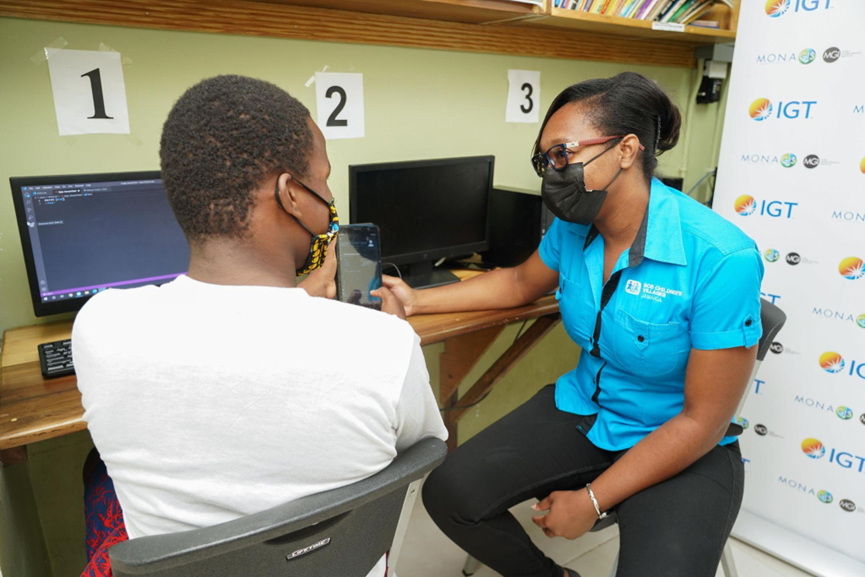
This young man shared his progress from the day’s coding and robotics activity with Hilary Nembhard of SOS Children’s Village Jamaica’s Stony Hill location during the 2023 Coding and Robotics Rock! Camp. (Photo: Contributed)

The Level I course introduced students to the fascinating world of computer science, providing a foundational understanding of coding and computing, exploring careers in the industry, and developing essential skills such as website development and robotics.

Specifically, the Level I course aimed to:

  • Build awareness of coding and its applications.
  • Inform about potential careers for developers.
  • Develop basic computing and development literacy.
  • Teach the basics of computer programming.
  • Introduce website development.
  • Explore robotics.
  • Enhance problem-solving skills

For returning students in Level II, this year’s programme built upon the knowledge gained last summer, with afocus on more complex web development, including HTML, CSS, and JavaScript, and an introduction to artificial intelligence.

The Level II course aimed to:

  • Provide a refresher on last year’s content.
  • Improve website development skills with advanced techniques.
  • Introduce the principles of artificial intelligence.
  • Further develop problem-solving skills.

An exciting new feature of this year’s camp was the provision for the intermediate robotics class to develop hands-on robot creation.

Green encouraged students to embrace this learning adventure with enthusiasm and curiosity.

“The skills you acquire here will not only open doors to exciting career opportunities but also equip you to become innovators and problem-solvers in our ever-evolving digital world,” she said.

Green also extended heartfelt thanks to partners at MGI and the UWI team for their unwavering support and collaboration in making this camp a success.

“Your dedication to nurturing young minds and fostering technological skills is truly commendable,” she added.

Source: Our Today

Prof Louis Grant: A hero for health

Jean Lowrie- Chin

Professor Louis Grant

Last Friday we gathered at the former Foundation for International Self-Help Jamaica Limited (FISH) Clinic to celebrate the 40th anniversary of the renamed Louis Grant Medical Centre in honour of its founder, Professor Grant. The beloved professor created the clinic in 1975 at 19 Gordon Town Road, near Papine, to serve less fortunate Jamaicans.

In her tribute at the event, his daughter, Bette Grant Otunla, traced the humble beginnings of this son of Mitchell Town, Clarendon, whose love of learning gained him the Vere Trust Scholarship to Jamaica College at a time when the College was a school for the privileged. The outstanding student was recommended by his headmaster, William Cowper, to take up a position at the government laboratory. This involved working visits to the Kingston Public Hospital where young Grant became interested in medicine, and with his savings and assistance from his family, enrolled at University of Edinburgh.

“He graduated in 1939 with his medical degree, three months before World War II started, and returned to the government laboratory in Jamaica,” shared his daughter. Soon after “he was awarded a Rockefeller Foundation scholarship to do a master’s in public health at the University of Michigan in the USA, which then had one of the best public health programmes in the world … [He] set up an excellent system of laboratory services in Jamaica on his return,” she said. This continues to be a linchpin of Jamaica’s health system.

Professor Grant was one of the first members of staff at the newly established The University College of the West Indies (UCWI) and was awarded a scholarship to study bacteriology at London School of Tropical Medicine and Hygiene. Thus armed, he set up the Department of Bacteriology at The UCWI. His research on tropical diseases led him to appeal to the World Health Organization and UNICEF to provide vaccines for an islandwide immunisation operation. We can thank the goodly professor for the eradication of tuberculosis in Jamaica.

Further, he noted the suffering of patients with leptospirosis and embarked on a public education campaign so Jamaicans would learn to protect themselves from rats, which carried this often-fatal disease. When equine encephalitis became widespread among horses, Professor Grant set up an area for animals near the Mona Post Office where he could test and treat them.

The professor used his knowledge to help protect Jamaica’s livestock. One of his colleagues at the Department of Bacteriology, Dr Owen James, recalled, “Outside of the department in nearby communities like August Town or further afield in St Thomas, chickens or goats or horses or other animals would be kept in certain areas and checked from time to time. This could signal a warning of an imminent outbreak of a particular disease, based on the findings from these ‘Sentinel stations’.”

Source: Jamaica Observer