Students from Mustard Seed Communities Mary’s Child (in white) learn about the fundamentals of robots in a coding session with Darren Fletcher, Technical Project Coordinator at Mona Geoinformatics Institute (MGI) while Luke Buchanan (left), MGI Executive Director, Debbie Green (centre), IGT General Manager and Kevin Johnson (right), MGI Software Developer watch attentively. This year’s staging of the Coding and Robotics Rock! Camp is hosted by IGT in collaboration with MGI. The virtual camp ran from July 15 – 26 with 72 participants from five Caribbean countries: Jamaica, Barbados, St. Kitts and Nevis, Trinidad and Tobago, St. Maarten. This is the fourth edition of the annual camp. (Photo: Contributed)
International Game Technology (IGT), a global leader in gaming technology and innovation, is pleased to announce the successful completion of its fourth annual IGT Coding and Robotics Rock! Camp for Caribbean youth, held July 15-26.
IGT partnered with the Mona Geoinformatics Institute (MGI) to host the virtual camp, under the theme “Climate Action.”
The camp serves as an extension of IGT’s global After School Advantage programme.
Debbie Green, general manager of IGT Jamaica, delivered remarks at the start of the camp, underscoring IGT’s commitment to digital learning and community empowerment.
“As part of IGT’s Sustainable Play programme, our After School Advantage initiative is devoted to providing youth with access to technology and promoting digital learning opportunities in the communities where IGToperates. This camp is a shining example of our commitment to these goals,” said Green.
Since its inception in 2021, this regional tech learning camp has seen remarkable growth. What began as a pilot programme for 36 participants across five countries has flourished into a signature IGT ASA project, significantly impacting our communities.
In 2022, the camp expanded to include a Level II component, increasing the cohort to 72 students at both the Introductory (Level I) and Intermediate (Level II) levels. Hundreds of Caribbean youth have gained valuable knowledge in coding and robotics through this camp.
This year, students participated from Jamaica, Trinidad and Tobago, St. Kitts and Nevis, Barbados, and St.Maarten.
Jamaican participants hailed from Mustard Seed Communities – Matthew 25:40, Mary’s Child, and Jerusalem; Spring Village Development Foundation; and the Women’s Centre of Jamaica Foundation in Mandeville and Savanna-la-mar. Barbados participants were from The Learning Centre and the Rupert I. Maynard Youth Community Centre; St. Maarten – St. Maarten Youth Council; Trinidad and Tobago – Sophia House, Cotton Tree Foundation, Amica House and Credo Boys; and St Kitts and Nevis – Maude Crosse Preparatory School.
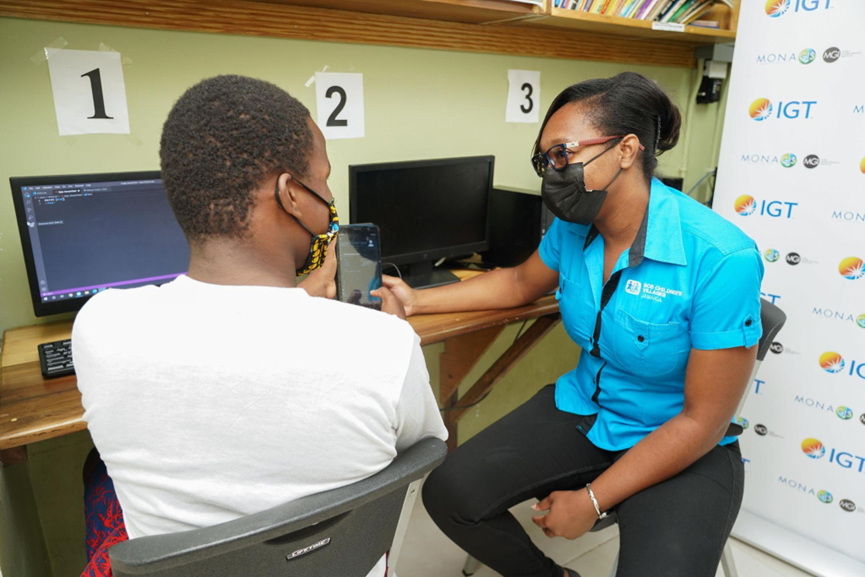
This young man shared his progress from the day’s coding and robotics activity with Hilary Nembhard of SOS Children’s Village Jamaica’s Stony Hill location during the 2023 Coding and Robotics Rock! Camp. (Photo: Contributed)
The Level I course introduced students to the fascinating world of computer science, providing a foundational understanding of coding and computing, exploring careers in the industry, and developing essential skills such as website development and robotics.
Specifically, the Level I course aimed to:
Build awareness of coding and its applications.
Inform about potential careers for developers.
Develop basic computing and development literacy.
Teach the basics of computer programming.
Introduce website development.
Explore robotics.
Enhance problem-solving skills
For returning students in Level II, this year’s programme built upon the knowledge gained last summer, with afocus on more complex web development, including HTML, CSS, and JavaScript, and an introduction to artificial intelligence.
The Level II course aimed to:
Provide a refresher on last year’s content.
Improve website development skills with advanced techniques.
Introduce the principles of artificial intelligence.
Further develop problem-solving skills.
An exciting new feature of this year’s camp was the provision for the intermediate robotics class to develop hands-on robot creation.
Green encouraged students to embrace this learning adventure with enthusiasm and curiosity.
“The skills you acquire here will not only open doors to exciting career opportunities but also equip you to become innovators and problem-solvers in our ever-evolving digital world,” she said.
Green also extended heartfelt thanks to partners at MGI and the UWI team for their unwavering support and collaboration in making this camp a success.
“Your dedication to nurturing young minds and fostering technological skills is truly commendable,” she added.
On Tuesday, February 11, 2025 the Digicel Foundation launched their ‘Safer Internet Together’ (SIT) programme at The UWI, Mona. The programme, which was launched on Safer Internet Day 2025, targets STEM programmes at over 150 educational institutions. From left: Avryl Francis, Security Operations Manager, Digicel; Antoinette Heirs, Digicel Foundation Board Director; Dr Terri-Karelle Reid, Founder of Open Door Jamaica Foundation; Charmaine Daniels, Digicel Foundation CEO; and Joy Clark, Board Chair of Digicel Foundation.
The internet offers a world of possibilities, providing benefits and opportunities. It has made everyday life more convenient and knowledge more accessible. However, the online world is far from perfect. It has become a confusing, complex space for many Jamaicans to navigate. At times, the internet can seem like an unsafe place to be.
What are the dangers lurking in the digital landscape – and how can we protect ourselves? Addressing these concerns, the Digicel Foundation officially launched its Safer Internet Together (SIT) Programme on Tuesday, February 11, 2025. This year-long initiative puts the emphasis on online safety, digital responsibility and cyber awareness – for all Jamaicans.
The launch event at the Mona School of Business and Management, University of the West Indies (UWI), Mona, observed Safer Internet Day 2025, under the theme “Together, For A Better Internet.” Digicel Foundation will roll out the SIT initiative in 150 educational institutions, in partnership with the ministry of Education, Skills, Youth and Information, STEM Builders Learning Hub, United Nations Children’s Fund (UNICEF), Sunshine Snacks, Jamaica Public Service Company (JPS), and MacMillan Education.
As CEO of Digicel Foundation Charmaine Daniels pointed out [in a Letter to the Editor] the programme of activities will be inclusive, “engaging diverse groups across the country on digital literacy and online responsibility.” Daniels added: “Furthermore, in partnership with the Caribbean Community of Retired Persons (CCRP), we will conduct specialised sessions during Senior Citizens’ Month in September to help older adults recognise and protect themselves against online threats.”
Marcelo Cataldo, CEO of the Digicel Group explained the programme’s goal: “We work every day to have our Internet available to our customers, but we are also mindful of the potential risks that the internet poses for young children. With the Safer Internet Together programme, we intend to raise awareness on how to mitigate the space carefully, with the help of all our sponsors.”
“Our responsibility at Digicel is to work together to help the new generation to be safe and to be protected.”
Assistant Commissioner of Police in charge of Technology, Leonardo Brown, in a dynamic presentation at the launch, reminded participants: “The internet and connectivity never forgets; whatever you post remains somewhere.”
Audience member Christoph Tucker reacted: “This day provides opportunities to learn about online risks, how to stay safe online, where to get help, and how to gain a better understanding of the laws.” He stressed: “There are so many young children nowadays using tablets. We want to ensure that they’re always safe and exposed to the right content, so that they become good people within our society.”
The Digicel Foundation CEO urged stakeholders and Jamaicans, young and old: “As we observe Safer Internet Day, let us commit to making the internet a place of opportunity rather than a source of harm. Let us foster a culture of responsible digital citizenship, ensuring that everyone – regardless of age or background – can explore the online world safely and confidently.”
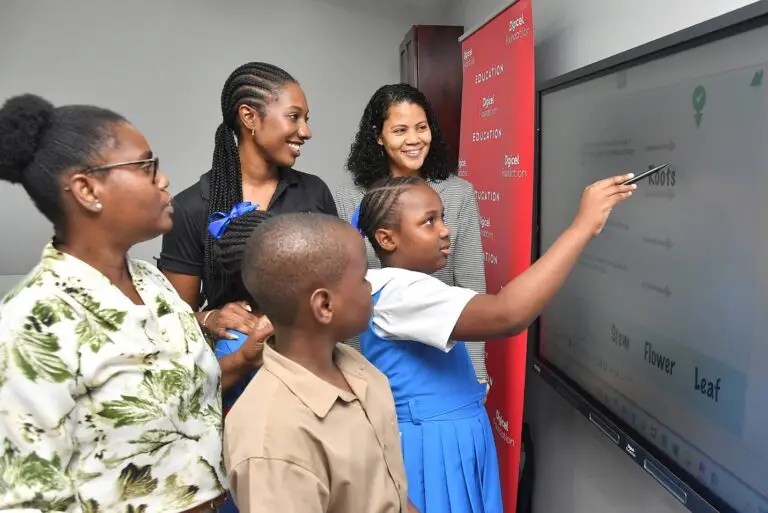
Amira Anderson of Mountain View Primary and Infant School interacts with the Coldax Smart touchscreen device donated by Digicel Foundation. Looking on from left are Mountain View Primary Principal Michelle Robinson, student Steve Richards, senior operations manager at Digicel Foundation Jodi-Ann McFarlene; and Leanne Spence, product training and development manager at Coldax Smart. Occasion was the official handing over ceremony of a smart lab by Digicel Foundation to Mountain View Primary and Infant School on Wednesday. (Photo: Naphtali Junior)
With Mountain View Primary and Infant School becoming the 12th school to receive a new smart lab from the Digicel Foundation, permanent secretary at the Ministry of Education Dr Kasan Troupe is urging teachers to maximise the use of technology in schools and give students more opportunities to engage with the devices.
“Teachers, do not be afraid of it. It is for use, for learning, for exploring,” she said at the handing-over ceremony of a smart lab on Wednesday at the Mountain View Primary and Infant School.
Dr Troupe expressed disappointment that, based on her observations, some schools have not been making full use of these devices mainly due to the fear of students damaging them. However, she is urging teachers to take a different approach by spending more time training students to use the devices instead of locking them away.
“I have had the opportunity to go into some schools and see the labs closed because teachers are fearful that the students will damage the equipment. We just need to train the students how to utilise the devices. But do not lock it away from the children. Please give them access, please excite them as they continue to champion their future with the support of the Digicel Foundation, the Ministry of Education, and the families who continue to partner in education,” she urged.
Dr Troupe used the opportunity to laud the Digicel Foundation for its support and commitment, especially with the challenges still affecting the education sector.
“Whenever you invest in education you invest in the future of our country and the Digicel Foundation has always been with us. When COVID came, we knew not what to do and we had our students with special needs who were at a disadvantage because they were out of the space, and the Digicel Foundation was the first entity to partner with the Ministry of Education to make sure that there was access to our students with special needs,” she saidAdditionally, enrichment programme specialist at the Ministry of Education Shauner Murray echoed Dr Troupe’s sentiments, emphasising the need to prioritise sustainability to ensure long-term durability of the devices.
“There ought to be a way to help stakeholders to understand the value of what they have so that after the initial planting of these seeds, these ventures can be sustained. Sustainability has to be a key aspect of our understanding. Sustainability is critical so that this immeasurable value will not just serve those who are current, but will serve those who are to come, especially the younger children entering grade one,” said Murray.
She urged parents, teachers and other representatives in the Ministry of Education to protect these investments and maximise their potential.
In the meantime, board chairman at the Mountain View Primary and Infant School Howard Chamberlain Jr expressed gratitude for the Digicel Foundation’s contribution, noting that the smart lab will have a positive impact on student performance at the school, especially in the Primary Exit Profile (PEP).
He said the lab will play a major role in bridging the digital divide among students at the school.
“We are placed in an area, in a community where the majority of the students that come to us are at-risk [and] majority of the students that come to us are from low-income families, and as such our role and our job is very important to ensure that we guide them on a path that they can further enrich their lives and develop their communities,” he said.
The lab, he added, is an important step for students and teachers to embrace the importance of involving more technology in schools.
“This smart lab comes at an important time where we are pivoting or shifting our focus to see how best we can push the use of technology in education here at Mountain View; we hear about AI coming up, kids using phones, and stuff like that, and we are having this tug-of-war with them, to push them to the sort of book and pencil that we grew up on, but the truth of the matter is that this generation has changed. They are far ahead of us and some of these technology and these intellectual programmes, we have to embrace them and find ways to include them in education,” he said.
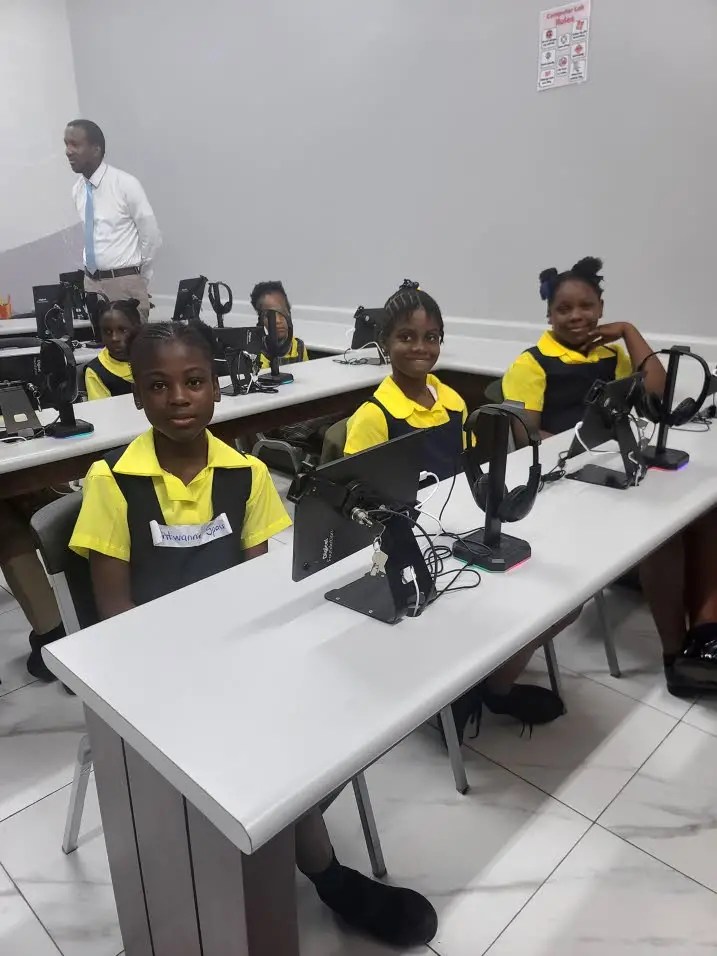
The smart lab is outfitted with laptops, tablets and a smart board that will be used to facilitate teaching and learning at the school.
The Digicel Foundation smart labs project is an initiative aimed at equipping 21 schools across Jamaica with technology to enhance learning and bridging the digital divide in schools.
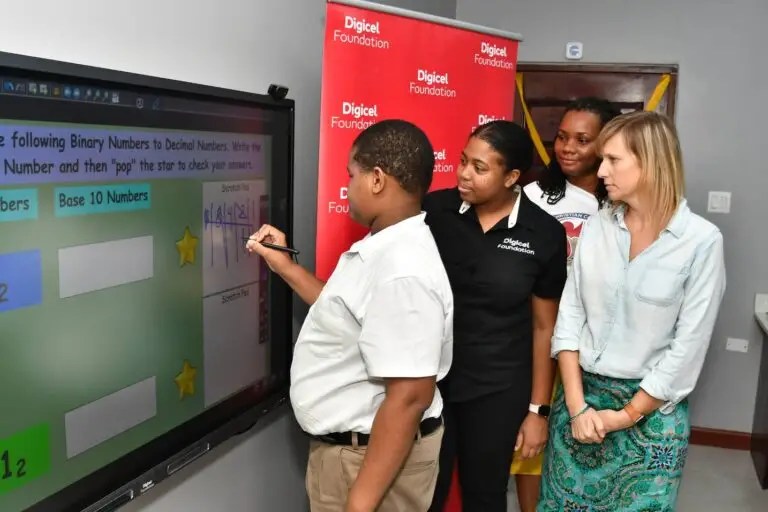
(From left) Student Morsell Weir; communications officer at Digicel Foundation, Kedisha Clarke; principal at the Caribbean Christian Centre for the Deaf, Kingston Campus, Terri Ann Bernard and mathematics teacher, Leah Gregg engage with the smartboard in the smart lab at the Caribbean Christian Centre for the Deaf on Monday. Photos: Karl Mclarty
CAROL Robertson, board chair at the Caribbean Christian Centre for the Deaf, is optimistic that the school’s new smart lab, courtesy of the Digicel Foundation, will create “a more level playing field” for students now and in the future as they navigate and find new ways to bridge the gap for students living in Jamaica with disabilities.
“Technology and the way that it is being used now actually creates a more level playing field because you no longer have to be impatient with the communication barriers of the hearing world,” Robertson told the handing-over ceremony held at the school’s Kingston campus on Monday.
She told the students that they can now adequately represent themselves and participate in the world out there — the global economy — through digital tools, which she said is very important.
Robertson noted that this initiative is important for students as it provides them with a platform to grow and sharpen their skills, despite their challenges.
“There are many persons out there in the world who are performing very skilled professions behind a digital screen and they are having the same results simply because they are no longer viewed as somebody who needs extra assistance. I am a part of your community, and we feel that we don’t necessarily get all open doors because people assume that we can’t,” said Robertson.
She urged students to make use of the devices and capitalise on the opportunity gifted to them by the foundation to maximise their potential.
“Get involved [because] technology will always be scary for somebody. Don’t let it be scary for you. Embrace it, and as the Caribbean Christian Centre for the Deaf and everything that we represent that is godly, it is your responsibility to use the technology in a positive way, honouring God as you go while you use it to serve yourselves,” Robertson said as she encouraged the students.
The Caribbean Christian Centre for the Deaf, Kingston campus, became the 13th school to receive a smart lab under the Digicel Foundation project to put 21 smart labs into schools.
However, this contribution stands out for more than just providing 12 laptops, 12 tablets, and an interactive smart board like other schools in the programme. According to Kedisha Clarke, communications officer at Digicel Foundation, the room also includes customised features tailored to the unique needs of the students.
“So the space was specially retrofitted to meet the unique needs of our deaf students, [and] the advancements include a visual alert doorbell providing a visual cue for students and staff, a network-attached storage system enabling the recording and storage of large video files, including sign language recordings [and] a high quality webcam facilitating clear and effective communication through video conferencing and online learning platforms,” she said. This smart lab is the second to be established in a special needs institution and the first ever by the foundation in a school for the deaf.
In the meantime, the school’s principal, Terri-Ann Bernard, reflected on the process of building the smart lab, noting that it offers teachers the opportunity to diversify their lessons by introducing students to more interactive learning methods.
“When I bring experiences to them it sticks more. So an interactive board like the one that we’re about to demonstrate definitely goes for that interactive doing, which makes learning happen to a different academia, different learning styles, and the interactive tactile and kinaesthetic where you’re doing things and taking on concepts and making them come to real life is one of the things that Ithink definitely resonates with our students,” said Bernard.
Acting executive director of the Caribbean Christian Centre for the Deaf, John Meeks, also expressed his gratitude for the smart lab, emphasising how the partnership aligns with the school’s mission of “reaching, teaching, and nurturing” deaf students.
“When you bring two visions together — the Digicel Foundation’s commitment to bridging the digital divide and our mission to reach, teach, and nurture the deaf — the synergy created, the coming together of organisations, foundations with a vision of taking people to the next level only speaks well for the future,” Meeks said.
He emphasised that the smart lab is not just a technological upgrade but a transformative tool that will help bridge communication gaps and empower students.
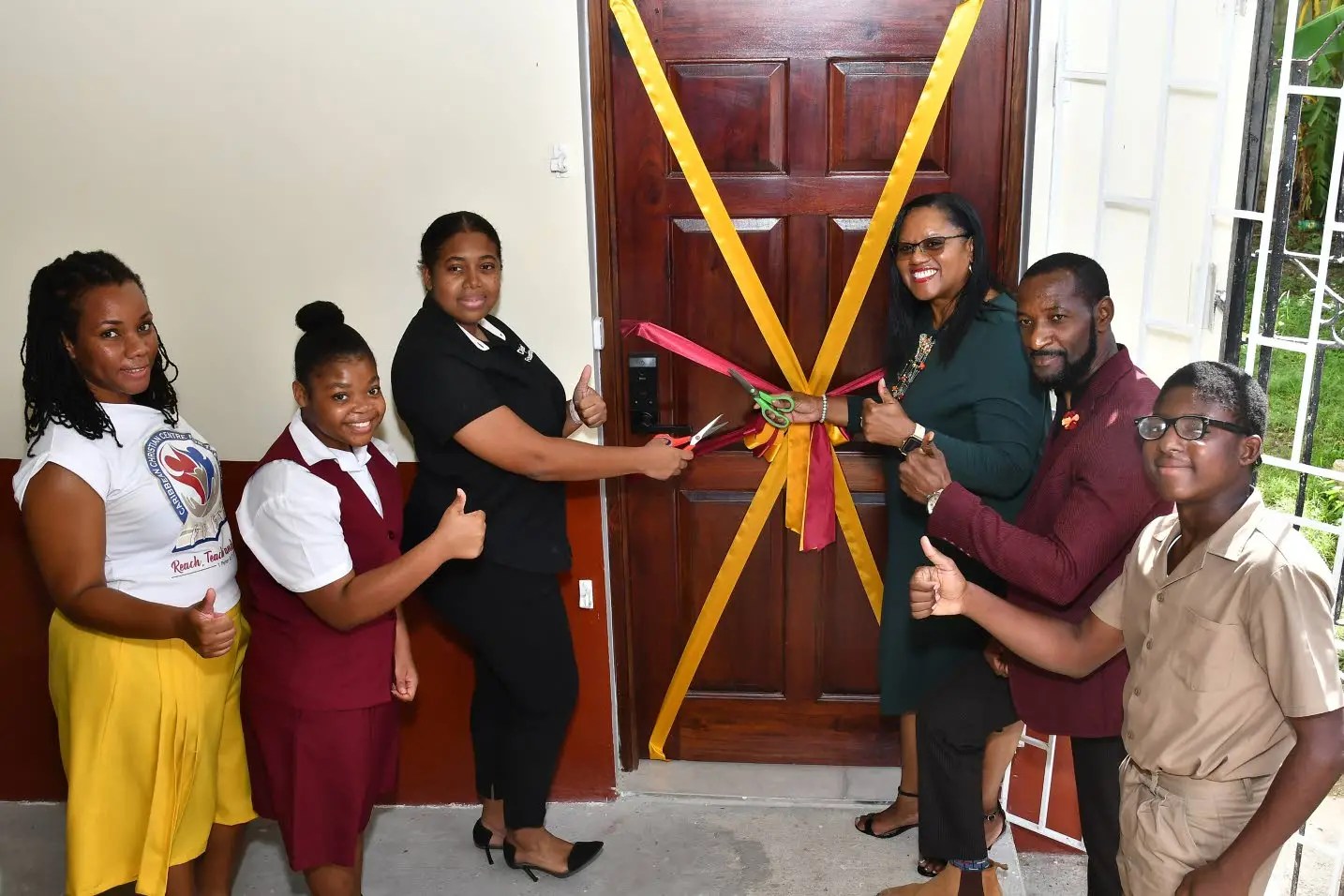
(From left) Principal at the Caribbean Christian Centre for the Deaf, Kingston Campus, Terri Ann Bernard; student Mackalia Sturlin; Communications officer at Digicel Foundation, Kedisha Clarke; chair of the centre Carol Robertson; acting executive director John Meeks; and student Nathaniel Ross cut the ribbon to signal the opening of the school’s new smart lab.
Tisha Wilson, IGT’s Administrative Supervisor, and youngsters at SOS Children’s Village Barrett Town display some of the books donated by the IGT team on Friday, September 22, 2023. Standing at the back of the room are house mothers Marcia Whyte (left) and Juliet Campbell. (Photo: Contributed)
Hewitt Walker, SOS Children’s Village director, is impressed with the progress of his residents after a comprehensive upgrade by International Game Technology (IGT) of their After School Advantage (ASA) computer lab at SOS Barrett Town, St James.
“Previously, students lacked convenient access to information to complete their assignments but now we are grateful to have a dedicated space where the residents can efficiently access resources needed for their academic tasks,” said Walker.
Generous donation
SOS Barrett Town was first equipped with an IGT ASA computer centre in 2013. In a recent upgrade, the company replaced previously installed desktop systems with 10 brand-new laptops equipped with updated software. In addition, IGT has provided a laptop storage cabinet and versatile multipurpose printer.
In observance of International Literacy Month, representatives of IGT made a generous donation of books to SOS Barrett Town earlier this month, engaging residents in a reading session.
Hosted under the theme ‘#IGTreads,’ this initiative reflects the organisation’s commitment to supporting education while emphasising the importance of literacy and reading. The theme was created for an IGT read-aloud initiative last year.
Debbie Green, IGT general manager, says she is elated to see the progress and growth in the IGT decade-long partnership with SOS Children’s Village Barrett Town under its After School Advantage programme.
“We remain committed to partnership and continued support of our centres under our After School Advantage programme, and we embrace the opportunity to nurture lifelong reading among our students, understanding that in the pages of books, we venture into a world of possibilities,” said Green.
Tisha Wilson, IGT’s administrative supervisor, along with two team members, were welcomed by a host of youngsters at the children’s village, who were thrilled to receive this book donation. Upon seeing the range of books being donated, the youngsters could not contain their excitement.
Support United Nations SDG
This positive reaction was a major goal as IGT is encouraging reading and awareness around the significance of literacy. This is also in support of the United Nations Sustainable Development Goals: Good Health and Well-Being, Quality Education, and Reduced Inequalities.
“The children were just so excited,” said Wilson. “The goal is to raise awareness for reading and improve literacy among our children. With technology and the Internet, we don’t have many readers, so for me, I was very surprised when we came in and the students were picking up books to find their favourite stories – even without us planning to engage them at that level. It was heart-warming to see students still having that interest to read.”
Walker believes that this initiative has the potential to ignite a passion for reading among the residents, particularly in an era dominated by technology, where reading is less common and social media use is more prevalent.
“I think it was a very good initiative because we live in a technological age and a lot of children use technology for social media, as opposed to reading, so a donation of books to the SOS Children’s Village is a good venture. This is a very important donation because it allows the kids to be exposed to books so that they can delve into stories and read more,” said Walker.
He, too, was impressed by the reaction of the youngsters.
“I think the kids are quite happy. They are looking for the books that they like and are enjoying them so far. I am very happy to see this because this is not something that you see very often in the village,” said Walker.
Improved literacy
House mothers at SOS Children’s Village Barrett Town Juliet Campbell and Marcia Whyte were also impressed by the initiative taken by IGT. For Campbell, IGT’s push for improved literacy plays an active role in their homework sessions.
“There are times when we have problems getting books at their reading level and I see that they have received a lot of those, so we are happy for them. We will engage them with more reading in the evenings after school,” Campbell said.
“I think this initiative will enhance the children in their vocabulary and help them to know new words,” said Whyte.
IGT shows its commitment to supporting education and technology access for youth through its After School Advantage (ASA) programme. The gaming technology firm has established 15 ASA computer labs in NGO-run institutions in Jamaica, including those in SOS Children’s Village Barrett Town and Stony Hill, Mustard Seed Communities – Matthew 25:40, Spring Village Development Foundation, Women’s Centre of Jamaica Foundation Mandeville and Savanna-La-Mar and Sunbeam Children’s Home in St Catherine.
SOS Children’s Village Barrett Town provides an alternative home for 38 children and young adults up to 22 years old who have lost parental care. SOS Children’s Villages International comprises more than 130 national associations around the world and has helped over four million children worldwide since its inception in 1949.
The 2023/2024 academic year starts on September 4. Joseph wellington
Technologyhas been a godsend for parents and children. Toddlers can be seen reading, singing along, and doing simple arithmetic via games before they even begin preschool.
As we hear parents complaining about the expensive booklists to get their children ready for “September morning”, we believe that more textbooks should be available online, although we understand that some workbooks may still have to be bought.
We welcome the news from Minister of Education and Youth Fayval Williams that her ministry will be holding sensitisation sessions to promote greater use of e-books. She posted on social media, “The biggest advantage of e-textbooks is the ability to include videos, animations, and simulations to help students understand complex concepts and make learning more fun.”
This sent me back to a lecture in 2017 by Edie Weiner, founder and CEO of Future Hunters. I share here revised excerpts from my column in April 2017 on her look at education.
Weiner turned to the hot topic of education, reminding us that the brain grows fastest before the age of three and that it is ridiculous that after being exposed to iPads and smartphones children are then taken to schools that are still using the same system that was designed for their grandparents. This was actually quoted at the finale of the Education Enrichment Programme, which, with the support of the then Ministry of Education, Youth and Information; USAID; and the Digicel Foundation, covered 104 schools, improving the literacy and numeracy of 43,000 primary school students.
The enrichment centres in 43 schools, which are heavy on information technology and bright visuals, particularly attractive to boys, have turned unenthusiastic students into high achievers. This was reinforced by Weiner as she demonstrated the difference between the way that male and female brains develop and what stimulates this development.
Weiner predicted a dramatic transformation in the delivery of education. According to her, information technology will make education available to millions in experiential forms. Therefore, she says, “critical thinking is the most important thing we can teach our young people”.
She says that all of this recent technology is creating disruption. “In future,” she says, “no one will be paying for ‘smart’, only ‘intelligent’. This is the kind of intelligence that will enable you to figure out things that you have never seen before.”
She suggested that university students should not major in any one thing but take multi-disciplinary courses and challenge themselves to see the connection. The Antiguan student who sat all 26 Caribbean Secondary Education Certificate (CSEC) subjects seems to have been on the right track.
While we need to limit the time our children spend on gaming, we should note that there is a brand new category of sports called e-sports. Wiener said that video games are evolving into competitive events, one of which was held in California, attracting 35 million online viewers. She said that universities will shortly be recruiting students who excel at e-sports for their teams.
IGT’s After School Advantage Programme, Digicel Foundation, and NCB Foundation this summer sponsored coding and robotics camps, gearing our children to make the best use of technology, learning how to create websites and apps that can create a better planet.
Let us allow our children to transition to the new school term, making use of technology to give them the best chance at navigating this Fourth Industrial Revolution described thus by the World Economic Forum (WEF): “The Fourth Industrial Revolution represents a fundamental change in the way we live, work, and relate to one another. It is a new chapter in human development, enabled by extraordinary technology advances commensurate with those of the first, second, and third industrial revolutions. These advances are merging the physical, digital, and biological worlds in ways that create both huge promise and potential peril.”
“The speed, breadth, and depth of this revolution is forcing us to rethink how countries develop, how organisations create value, and even what it means to be human. The Fourth Industrial Revolution is about more than just technology-driven change; it is an opportunity to help everyone, including leaders, policymakers, and people from all income groups and nations, to harness converging technologies in order to create an inclusive, human-centred future. The real opportunity is to look beyond technology and find ways to give the greatest number of people the ability to positively impact their families, organisations, and communities.”
The gift of technology is that regardless of the size of one’s country, the tools are there to help us stand shoulder-to-shoulder with leading professionals anywhere in the world. Let us seize the day.
Running for worthy causes
MBJ/TEAMSANGSTER 2022 5K winners Brandon Kerr (left) and Danielle Terrier
MBJ Airports Limited/Team Sangster raised $4.5 million last year from their run-walk, which went in entirety to academic grants for primary, secondary, and tertiary students. They are back again on Sunday, September 10, with generous sponsors stepping up to give great prizes: airline tickets from JetBlue, Spirit, and Virgin airlines; as well as weekend stays at Couples Resorts, Hyatt, Hilton, Zoetry, and S Hotel; and day passes at Royalton Luxury Resorts. Additional prizes include Chukka Adventure Tour excursions; tablets from Digicel; gift baskets from Tortuga, Reggae Mart, and CPJ; and gifts from the Airports Authority of Jamaica and MBJ Airports Limited. Participants will be refreshed after the race with breakfast, courtesy of Express Catering Limited, Goddard Catering Group, VIP Attractions Limited, and CPJ beverage station and will also be able to enjoy an after-race massage.
Deadline for registration is this Wednesday, September 6. The fee is $2,000 for adults and $1,500 for children. Participants will have the option to register for a 5/10K run or 5K walk, which will run from the commercial pickup area at the Sangster International Airport to Flanker/Whitehouse.
Meanwhile, Bert’s Auto Parts has partnered with Food For the Poor Jamaica in its 4oth anniversary Build Back the Love house-building programme. The Build with Bert’s 5K will be held on Sunday, October 1 at Emancipation Park, with the target of US$49,000, the cost of building 10 houses.
Marketing Manager Waynette Strachan noted that the company has been giving back over the years in appreciation of the support from their fellow Jamaicans. I can attest to that as Bert’s is a kind discount partner of CCRP.
Andrea Williams-McKenzie honoured with CBE
King Charles converses with Andrea Williams-McKenzie, CBE after her investiture.
Our family was delighted to learn that Andrea Williams-McKenzie was invested with the Commander of the Order of the British Empire (CBE) by King Charles III earlier this year at Windsor Castle.
A human resource development specialist, Williams-McKenzie has led significant projects for the Government. One of the most challenging was leading the workforce planning, resourcing, and training to support all UK borders for the 2012 Olympics, an unqualified success.
Williams-McKenzie volunteers widely. She was a school foundation governor for her church parish, chair of governors for the parish Roman Catholic primary school, and a Eucharistic minister. She has been volunteering at the winter homeless shelter and in other community activities.
Williams-McKenzie has joined the ranks of famous individuals who have been invested with the CBE, such as Stephen Hawking, Harold Pinter, Hugh Laurie, Jonny Wilkinson, and Helena Bonham Carter.







 Jamaica Highlights