IGT hosts 4th Coding and Robotics Rock! camp

Students from Mustard Seed Communities Mary’s Child (in white) learn about the fundamentals of robots in a coding session with Darren Fletcher, Technical Project Coordinator at Mona Geoinformatics Institute (MGI) while Luke Buchanan (left), MGI Executive Director, Debbie Green (centre), IGT General Manager and Kevin Johnson (right), MGI Software Developer watch attentively. This year’s staging of the Coding and Robotics Rock! Camp is hosted by IGT in collaboration with MGI. The virtual camp ran from July 15 – 26 with 72 participants from five Caribbean countries: Jamaica, Barbados, St. Kitts and Nevis, Trinidad and Tobago, St. Maarten. This is the fourth edition of the annual camp. (Photo: Contributed)

International Game Technology (IGT), a global leader in gaming technology and innovation, is pleased to announce the successful completion of its fourth annual IGT Coding and Robotics Rock! Camp for Caribbean youth, held July 15-26.

IGT partnered with the Mona Geoinformatics Institute (MGI) to host the virtual camp, under the theme “Climate Action.”

The camp serves as an extension of IGT’s global After School Advantage programme.

Debbie Green, general manager of IGT Jamaica, delivered remarks at the start of the camp, underscoring IGT’s commitment to digital learning and community empowerment.

“As part of IGT’s Sustainable Play programme, our After School Advantage initiative is devoted to providing youth with access to technology and promoting digital learning opportunities in the communities where IGToperates. This camp is a shining example of our commitment to these goals,” said Green.

Since its inception in 2021, this regional tech learning camp has seen remarkable growth. What began as a pilot programme for 36 participants across five countries has flourished into a signature IGT ASA project, significantly impacting our communities.

In 2022, the camp expanded to include a Level II component, increasing the cohort to 72 students at both the Introductory (Level I) and Intermediate (Level II) levels. Hundreds of Caribbean youth have gained valuable knowledge in coding and robotics through this camp. 

This year, students participated from Jamaica, Trinidad and Tobago, St. Kitts and Nevis, Barbados, and St.Maarten.

Jamaican participants hailed from Mustard Seed Communities – Matthew 25:40, Mary’s Child, and Jerusalem; Spring Village Development Foundation; and the Women’s Centre of Jamaica Foundation in Mandeville and Savanna-la-mar. Barbados participants were from The Learning Centre and the Rupert I. Maynard Youth Community Centre;  St. Maarten –  St. Maarten Youth Council; Trinidad and Tobago – Sophia House, Cotton Tree Foundation, Amica House and Credo Boys; and St Kitts and Nevis – Maude Crosse Preparatory School. 
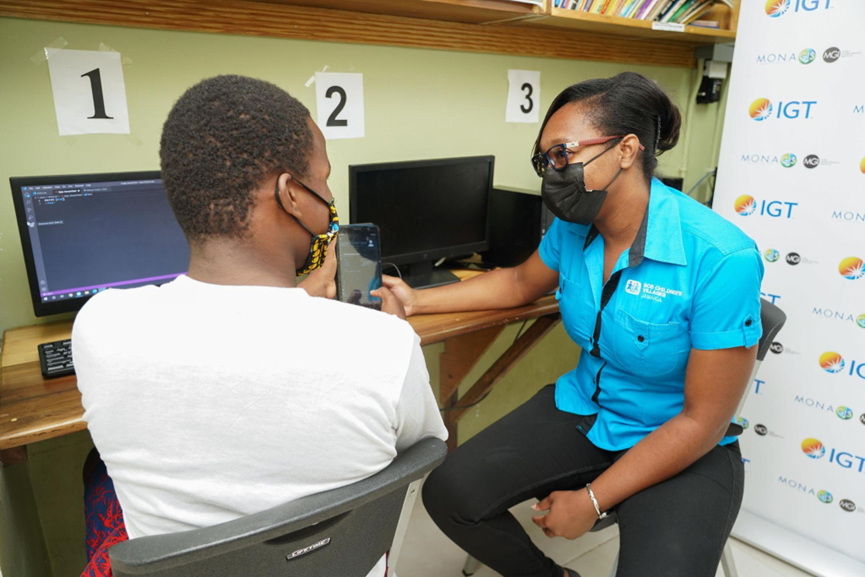
This young man shared his progress from the day’s coding and robotics activity with Hilary Nembhard of SOS Children’s Village Jamaica’s Stony Hill location during the 2023 Coding and Robotics Rock! Camp. (Photo: Contributed)

The Level I course introduced students to the fascinating world of computer science, providing a foundational understanding of coding and computing, exploring careers in the industry, and developing essential skills such as website development and robotics.

Specifically, the Level I course aimed to:

  • Build awareness of coding and its applications.
  • Inform about potential careers for developers.
  • Develop basic computing and development literacy.
  • Teach the basics of computer programming.
  • Introduce website development.
  • Explore robotics.
  • Enhance problem-solving skills

For returning students in Level II, this year’s programme built upon the knowledge gained last summer, with afocus on more complex web development, including HTML, CSS, and JavaScript, and an introduction to artificial intelligence.

The Level II course aimed to:

  • Provide a refresher on last year’s content.
  • Improve website development skills with advanced techniques.
  • Introduce the principles of artificial intelligence.
  • Further develop problem-solving skills.

An exciting new feature of this year’s camp was the provision for the intermediate robotics class to develop hands-on robot creation.

Green encouraged students to embrace this learning adventure with enthusiasm and curiosity.

“The skills you acquire here will not only open doors to exciting career opportunities but also equip you to become innovators and problem-solvers in our ever-evolving digital world,” she said.

Green also extended heartfelt thanks to partners at MGI and the UWI team for their unwavering support and collaboration in making this camp a success.

“Your dedication to nurturing young minds and fostering technological skills is truly commendable,” she added.

Source: Our Today

Five UWI students get engineering scholarships from Marubeni

Mohamed Majeed (second right), managing director of Caribbean operations for Marubeni Power International, shares words of encouragement with UWI electrical engineering students and Marubeni scholarship recipients Daniel McGregor (left) and Rochelle Stephen during the scholarship presentation ceremony at The University of the West Indies, Mona campus on September 27, 2023. Also present is Damian Obiglio, senior vice-president, Marubeni Power International.

FIVE students pursuing engineering degrees at The University of the West Indies, Mona campus received a funding boost in their journey courtesy of scholarships totalling US$20,000 provided by Marubeni Power International in collaboration with The UWI Development and Endowment Fund (UWIDEF).

The students, Brianna Smith, Daniel McGregor, Martin McDonald, Dwight Simpson, and top performer Rochelle Stephen, were presented with their scholarship cheques during a brief ceremony at the Principal’s Council Room on September 27.

Addressing the gathering, Managing director of Caribbean operations for Marubeni Power International Mohamed Majeed praised the exceptional quality displayed by the five recipients, highlighting the proven benefits of higher education in enabling individuals to increase their earning power.

Marubeni, he said, was pleased to enable the students to take their rightful place as problem-solvers of the future. “We commend your accomplishments thus far and anticipate the impact you will undoubtedly have as you progress both academically and in your future careers,” he said.

His Excellency Yasuhiro Atsumi, Japanese Ambassador to Jamaica, in his address, said all Japan stood in support of the development efforts of the Jamaican Government and people for continued progress. In praising Marubeni for its generosity in funding the scholarships, the ambassador noted several previous occasions in which the company had given generously to support education, most notably in donating tablet computers to enable virtual learning during the COVID-19 pandemic. Ambassador Atsumi said he looked forward to many more acts of support for Jamaica’s development both on the part of Marubeni as well as the Government of Japan.

Representing the Ministry of Education, National Mathematics Co-ordinator Dr Tamika Benjamin spoke to the growing importance of engineering and other STEM subjects in the modern development model. In congratulating the recipients, she likewise encouraged them to become problem-solvers on the national level and expressed the hope that their performance would in turn encourage greater participation in STEM education.

Reynold Scott, board director of UWIDEF, also urged the students to continue to do their very best, adding that programmes such the scholarship presentation are at the heart of the fund’s function.

Responding on behalf of the quintet, Rochelle Stephen reiterated the “life-changing” nature of the scholarship, adding that she was unable to fully express the importance of being able to continue on their respective educational journeys. She pledged to heed the call for continued excellence and bring honour to the institution, to their families and the nation.

UWIDEF Project Officer Francine Warren-Kidd, who presided over the ceremony, thanked Marubeni and all the partners involved in bringing the scholarship presentation to fruition. The ceremony, she said, marked not the end of the collaboration, but a new beginning.

Marubeni, in seeking to contribute to the development of Jamaica, has been supporting worthy initiatives in a number of areas, education being primary among them.

Source: The Jamaica Observer https://www.jamaicaobserver.com/news/five-uwi-students-get-engineering-scholarships-from-marubeni/

Children gain robotics skills at Digicel Foundation’s summer camp

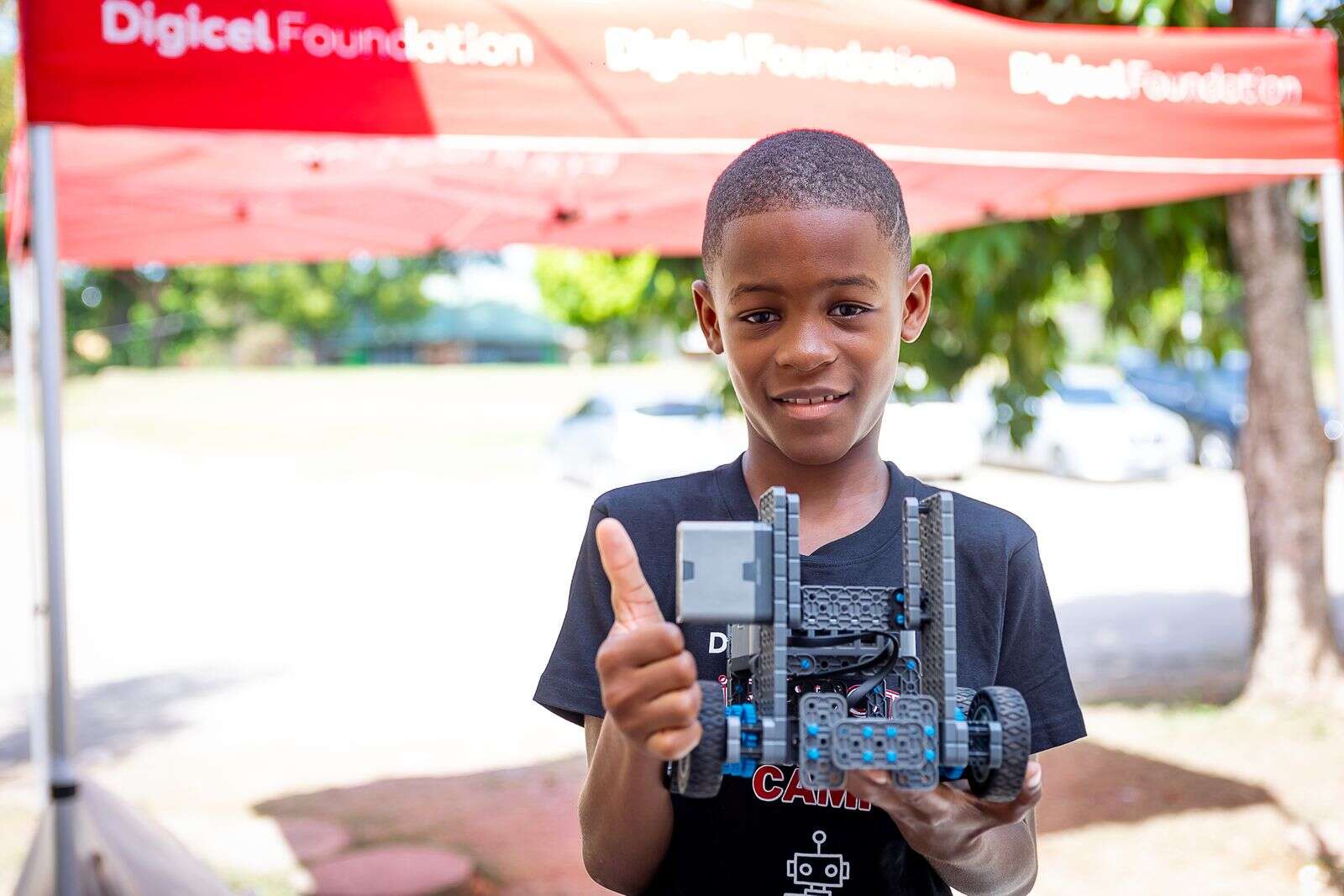
Nichoy Moses displays a VEX IQ robot he helped to build at the Digicel Foundation-sponsored iRobots summer camp held recently.

KINGSTON, Jamaica – Over 30 children at the primary level learned about robots and coding, as well as teamwork and creative problem-solving, at a recently held robotics summer camp.

The camp was organised in partnership with the Digicel Foundation, KRW Tronics and Jamaica Theological Seminary.

Director of Strategic Planning and Community Development at the Digicel Foundation, Miguel ‘Steppa’ Williams shared that the camp has served as a launching point for young people interested in Science, Technology, Engineering, Arts and Mathematics (STEAM) careers.

He said, “The camp offers hands-on experience in robotics technology and equips them with the necessary tools to inspire the next generation of young inventors, scientists, and engineers. The children were introduced to the exciting world of robotics, fostering creativity, problem-solving skills, and teamwork.”

Robotics camp instructor, Jerome Morrison, shared that the camp’s curriculum was expertly crafted to provide a hands-on and interactive learning environment.

“The children learned about the VEX IQ robot and how to programme it from a device. They also used the Scratch platform to build their own game. Most of the tasks given were completed collaboratively to help build team-building skills. Overall they showed high levels of interest in robotics,” said Morrison.

Morrison explained the importance of teaching children robotics skills from an early age. He noted, “We live in a much-computerised era now. They call this era the 4th industrial revolution which also involves STEAM education. Therefore, it is good for students to learn about these skills from a young age because, in the future, robots are going to be very common, almost as common as the laptop and smart devices that we use on a daily basis. It will be very beneficial to the children to learn about robots from now so it doesn’t become strange to them and as they grow, they will have an opportunity to enhance the knowledge and skills they developed from that young age.”

For 10-year-old Kiszey-Anna Clarke, the robotics camp allowed her to meet and interact with other kids. “I gained a lot of new friends who have similar interests as me. We can operate robots as a team and we learned a lot together.,” she said.

Meanwhile, for Nichoy Moses, a nine-year-old budding scientist, the robotics camp provided him with an opportunity to explore new skills. He said, “I learned a lot of things for the first time such as programming. I really enjoyed assembling the robot and making it move and do things at our command.”

Source: Jamaica Observer | https://www.jamaicaobserver.com/latest-news/children-gain-robotics-skills-at-digicel-foundations-summer-camp/