Food For The Poor Looks To Break New Ground

ffp-1

Charity eyes special emergency-response team

Requests for emergency assistance for victims of natural disasters, fire and other tragedies are a feature of the workday for employees of Food For The Poor (FFP). However, one such phone call from Dr Omar Davies, member of parliament for St Andrew South, about a fire in Arnett Gardens late last year presented some challenges.

The call came about 7 p.m. on Christmas Eve, a Saturday, and, with the following Monday and Tuesday being public holidays, there would be no one in office for at least the next three days.

With the appeal being for immediate assistance for the fire victims – mattresses, food and clothing at least – the agency responded.

EMERGENCY RESPONSE

However, FFP Chairman Andrew Mahfood, acknowledged the situation highlighted the need for a specialised emergency response team to deal with such situations.

“I would actually like to see us be able to do that as well, because we are dealing with a situation where the people don’t have a place to sleep tonight. So if we can even get them some emergency supplies like mattresses, or clothing so they can at least get on their feet the next day, that would be good,” he told The Gleaner.

Proof of ownership impacting assistance in inner-city areas 

Andrew Mahfood, chairman of Food For the Poor, says the organisation’s ability to assist with the building of homes for persons in the inner city is being stymied by the beneficiaries’ inability to provide proof of ownership of the land or legal access to occupy the premises.

“It is one of the things that delays our effort considerably. If we were able to go into an area like Arnett (Gardens), where people have been living for many years, and just rebuild, the process would happen quicker, but we require proof of land ownership or lease, to show that they have the right to be on the land, to show that the taxes have been paid on the land. We need to ensure that our recipients have the right to be on the spot that we are building,” Mahfood said.

“What we’ve found in the past is that if we don’t follow those guidelines and regulations, we could end up building on lands that somebody else owns and then before you know it, somebody else comes and says, ‘You have to come out of that house, it’s my land’. But if we can somehow find a way where the lands in the inner city, the people can get the right to them, somehow it will speed up our efforts considerably.”

Charity organisation seeking to engage in community-development projects

Food For The Poor (FFP) is looking to partner with the State in community development in a more sustainable way, involving the construction of houses, community centres, places of worship, schools, etc.

“(The State) could give us plots of land where we can encourage community-type living and farming and co-operative-type. We’ve approached them and we’ve gotten initially some good feedback and it’s something we’re gonna have more discussion on. Agriculture presents a great opportunity for us and the people, given Food For The Poor’s ability to fund agriculture and water harvesting where you can put multiple tanks together with a source and feed it. Food For The Poor can, out in those tanks, we can put in pumps,” Food For the Poor Chairman Andrew Mahfood disclosed.

The charity organisation is now looking for recipients who are serious about getting into agriculture, especially with donors in the United States opting more to fund income-generating sustainable projects in agriculture, with water harvesting and sanitation issues a priority.

Said Mahfood: “We’re looking for areas where we can put in big water projects because donors in the United States are very interested in water, in being able to provide water and being able to provide sanitation. Those two areas we are finding our donors gravitating more towards. So let’s say that we have this project in a community, there is no running water. We can go and put in 30,000 gallons but once we confirm that there is a need, the office in Florida will then go to its donors and circulate it and get it funded.”

LOCAL BUSINESS SUPPORT

In the area of housing financing, which caters to individuals or families, more local businesses are taking an active interest by sponsoring 50 per cent of the cost of a standard Food For The Poor dwelling, which now stands at US$7,200. The charity organisation is quick to match any amount of such offers with a 50 per cent contribution.

Over the three-and-a-half decades of helping the less fortunate, political interference in its operations has been a non-issue, which Mahfood attributes to an appreciation of its stellar service.

“Our politicians and our Government, I think, do recognise that we can play a big role for the country and for them as well. If an MP is able to lobby Food For The Poor to do a lot of work in their area, it helps them. We don’t work with any particular MP. We want to work with every single MP in both parties. I believe that Jamaica, through the organisation, has a huge potential to do a lot more projects and we see those projects being funded in other countries. So one of the things that we have decided to for this year is to really mock up some very big projects and go after those donors in America that are funding the very same projects for other countries.”

Source: http://jamaica-gleaner.com/article/lead-stories/20170130/food-poor-looks-break-new-ground

Food For The Poor assists corn farmers

For hundreds of farmers across Jamaica, a single bag of corn seeds represents a great improvement not only for the quality of their harvest, but also for the betterment of their lives.

More than 1,200 bags of corn seeds were donated by Food For The Poor Jamaica to be distributed through the Jamaica Agricultural Society and the Rural Agricultural Development Authority across all parishes.

Omar Dennis, a farmer of 15 years, has seen positive changes since he received the seeds in August 2016.

Dennis, who is the sole breadwinner of his family, said reaping the produce from the donated corn seeds has benefited his family. In the past, he sometimes struggled to send his two children, ages 8 and 11, to school due to lack of funds.

“Now I am sure that I will be going home with money for my family. It feels good to know that I am able to provide food for them and I am sure that my children can go to school,” Dennis said.

Dennis expressed gratitude to Food For The Poor Jamaica for providing the seeds, which he could not afford to buy.

Corn seeds are very expensive. One bag of corn seed would actually cost us approximately J$30,000, so it is really a great venture,” he added.

Dennis Roberts, who has farmed for 30 years, expressed happiness with the high-quality crop that the corn seeds produced.

“It’s among the best quality that we have seen since planting corn for over the last 20 years,” he said.

Roberts added that the corn was able to survive the drought and resist diseases better than what he had grown in the past.

He also praised the charity for its contribution to farmers.

“We will save as a result of not having to purchase fertilisers, which means we will earn a greater profit,” Roberts said.

David Mair, executive director of Food For The Poor Jamaica, said the charity and its donors recognise the importance of agriculture to Jamaica’s development.

“Distributions such as this and our continued support of members of the agricultural sector represent our belief that agriculture is critical to Jamaica achieving socioeconomic growth,” Mair said.

Food For The Poor Jamaica contributes to farmers across Jamaica through its agricultural ministry and a number of initiatives.

ffp-3

Source: http://jamaica-star.com/article/news/20170130/food-poor-assists-corn-farmers

Food For The Poor Going Places

ffp-2

In 35 years of operation, the role of Food For The Poor (FFP) Jamaica, as well as the scope of its operations, has grown significantly as the charity continues to enable and enrich beneficiaries within and far beyond local shores.

As news of the humanitarian crisis in Haiti spread, following the widespread devastation by Hurricane Matthew last October, Jamaicans turned to FFP as a channel for their good intentions, a situation which Chairman Andrew Mahfood admits caught him off-guard.

“The Haiti relief, that was amazing. We started to get a couple calls right after the hurricane, and I am not sure if it’s because of how close it came to us, but the outpouring of support from Jamaica to us, to give to Haiti, was something we hadn’t seen before. Seventeen containers were shipped and J$12 million raised,” Mahfood told The Gleaner.

From humble beginnings at Emerald Road, Kingston, from which goods brought into the island through the Catholic Relief Service in 1982 were distributed, the phenomenal growth of the local chapter of this charitable non-profit organisation has been consistent with that of its parent company. Food For The Poor is the largest charity organisation in Jamaica, with Food For The Poor Incorporated, located in Florida, United States of America (USA), being the largest international relief and development organisation in the USA, assisting the poor in 17 Latin American and Caribbean countries.

“We did start as Food For The Poor, giving away food, but now the objectives of the organisation are so vast – housing, medical, social outreach, education, prison ministries, water and sanitation and agriculture,” the chairman explained.

He offered an explanation as to why more donors are looking to share of their bounty through the non-denominational entity. “I think what is happening is that we are connecting more with corporate Jamaica and through the good efforts of the media and the reporting on all the stuff that we do, that connection is growing. They are seeing the wide range of things that we are doing.”

People flock from far and wide to the head office of Food For The Poor (FFP) Jamaica at Ellerslie Pen, Spanish Town, in St Catherine, as soon as the doors open, from Monday to Friday.

There, some 135 staffers comprising what FFP Chairman Andrew Mahfood describes as “a good team out there” attend to the varied requests for assistance.

Investigators are the first responders, whether it’s a request for immediate help from a fire victim or to build a home for a family.

“Somebody has to actually go and visit the premises and say, ‘Yes, we’ve been to the location and we’ve seen the conditions they live under.’ So we get the picture and all of us see that it’s a genuine case,” Mahfood told The Gleaner.

Individuals seeking help may contact the organisation directly or through a church in their area, a pastor, justice of the peace, or member of parliament. However, FFP is working to help Jamaicans to help themselves, as well as others, Mahfood explained.

“The organisation has always felt that we have to get our recipients self-sufficient and into projects that are sustainable for them to provide an income. We believe that Jamaica provides a great opportunity for recipients to come together – either in a community and do a big agricultural project. Food For The Poor has the ability to fund those projects – put in homes, to put in, say, a community centre, to put in a place where people can go and pray, as well as schools. These are things that it can do in these communities.”

Source: http://jamaica-gleaner.com/article/lead-stories/20170130/food-poor-going-places

Gleaner Honour Awards A Big Deal, Say Recipients

gleaner-awards

Being recognised by The Gleaner through its annual Honour Awards carries a lot of weight. Representatives of four category winners – the Jamaica Public Service Company (JPS) for science and technology; the Calabash International Literary Festival for arts and culture; Food For the Poor, recipient for voluntary service; and National Commercial Bank for education – made that clear during yesterday’s second of three category luncheons hosted by the media house at its North Street, central Kingston, head office.

On Monday, February 20, The Gleaner will choose from the awardees the man, woman or company deemed best to have contributed significantly to improving Jamaica’s quality of life, at any time in the preceding 12 months, or is likely to bring about such a change in the immediate future.

For those honoured yesterday, the recognition has been invaluable.

“Clearly, when anybody in the arts is acknowledged for the work they do, it’s a big deal, because there is no monetary reward in the arts. So what you hope and pray for is that your work makes a difference in other ways. So when you get an award such as this one, it allows you to get more recognition, more prominence to be able to do work that you may not have been able to do otherwise. It gives you legitimacy and a stamp of approval that is so important in the arts,” Justine Henzell, co-founder and producer of the Calabash International Literary Festival, shared.

Andrew Mahfood, chairman of Food For the Poor, said it would serve as motivation to do even more for its charges.

“The organisation is humbled by this award from The Gleaner for voluntary service. We have a lot of work to do [because] there are a lot more people who are living in poverty conditions and we hope to be able to help them,” he disclosed.


Goes Way Beyond JPS


Meanwhile, Gary Barrow, chief technology officer for the JPS, spoke to the far-reaching impact of the award.

“We are really very excited because we think that this goes way beyond JPS. We are fortunate that the introduction of the new technology actually allows us to help Jamaica in terms of growth and prosperity, which is a critical part of our vision statement – that we are the people unleashing Jamaica’s growth and prosperity. So we understand the role energy plays in economic growth and we believe there is a really big opportunity out there to help us to use technology to accelerate that growth.”

Author Marlon James was also recognised with a special award in the arts and culture category.

The final category award luncheon is slated for Wednesday, February 1, when winners in the categories public service and business will be recognised, ahead of the February 20 grand gala event at The Jamaica Pegasus hotel in New Kingston.

christopher.serju@gleanerjm.com

22 Prisoners Get Early Release – Food For The Poor Pays Fines For More Non-Violent Inmates

ffpj-prison-release

Twenty-two inmates of the island’s prisons are now back with their families, having secured early release through the generosity of donors of the international relief and development organisation, Food For The Poor.

For more than 18 years, Food For The Poor has secured the release of non-violent offenders in Jamaica by paying their fines at Christmas and Easter. This act of kindness is also done for inmates in Guyana, Haiti, and Honduras.

Every year, poor Jamaicans are imprisoned for minor, non-violent offences because of their inability to pay their court fines, even if the amounts they are fined are minimal.

PRAYERS ANSWERED

The prayers of a former inmate in the St Catherine Adult Correctional Centre were answered when he was told that he would be freed late last year after being unable to pay his fine. Most of his money had been used to take care of his sick mother.

“It’s always just me and my mother. When I actually realised that I was going to be locked up, I couldn’t believe that this was happening to me but I prayed a lot and asked God to just keep me out of trouble and keep me sane so I could one day see my mother again,” said the non-violent offender.

According to the former inmate, Food For The Poor’s kindness in paying his fine has renewed his belief and hope in God.

“Food For The Poor coming to pay my fine today so that I can go home to my mother proves to me that God is real,” added the inmate.

Another former inmate broke down in tears when her name was announced as one of the persons whose fines had been paid by the charity.

“When I heard my name, I thought I was being asked to do an item on the programme. Little did I know it was much more than that. When the announcement was made the tears just started to flow, and I couldn’t stop crying,” she said.

David Mair, executive director of Food For The Poor Jamaica, said the prison release tradition is one that the organisation intends to continue because of the impact it has on inmates.

http://jamaica-gleaner.com/article/news/20170122/22-prisoners-get-early-release-food-poor-pays-fines-more-non-violent-inmates

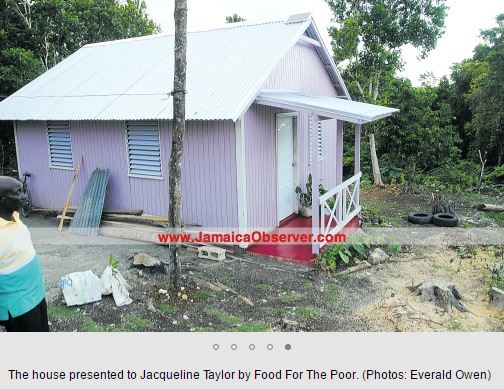
Food For The Poor assists family, elderly with houses

ffp-house

A Portland family and an elderly man are the latest beneficiaries of houses from philanthropic organisation Food For The Poor (FFP) after their plight was highlighted by the Jamaica Observer North East in 2015.

The family of four, which includes a wheelchair-bound man, was desperately in need of a house to get out of the crammed space they shared in the back room of a relative’s house in Waybridge, Portland, for years.

Observer North & East reported in 2015 that Jacqueline Thompson, her two daughters and her physically challenged son all shared a single bed in a room which an aunt allowed them to stay in, after they had been living in the garage for some time.

At the time, Thompson stressed that she needed help to get back on her feet.

“I am feeling happy about getting my house. I thank God as I can’t leave him out,” she said.

Thompson also thanked justice of the peace and pastor of the Church of God in Christ at Long Road, Roy Titus, who tried desperately to get assistance for the family. He described their situation as “dire,” then.

She also thanked the Ministry of Housing for the land space, Food For The Poor for the house, the Observer for highlighting her need, and the parish council and the National Insurance Scheme for their assistance.

“I am a happy person now. It was a long and horrible wait; I cried sometimes. The children are very happy, especially my son Okeno,” Thompson shared.

The house, which is located at Darlingford Housing Scheme in Manchioneal in the parish, was handed over last October. Thompson said FFP has also pledged to donate furniture.

A visually impaired elderly man was also the beneficiary of a house from FFP.

Urnal Taylor lived in a dirt-floor, one-bedroom house in Boston in the parish for years, before FFP read of his plight in the

Observer and presented him with the keys for a new house.

“This house is beautiful as much as mi can’t see it. I am comfortable and mi have space. Thanks to all the people who helped me, and the gentleman here, Pastor Titus. The blessings on his shoulders can’t come off. Welcome; welcome,” he said with a broad grin on his face.

http://www.jamaicaobserver.com/regional/Food-For-The-Poor-assists-family–elderly-with-housesObserver-North-and-East-article-spurs-action——-_87286

Food For The Poor Brings Joy To Golden Agers

ffp2

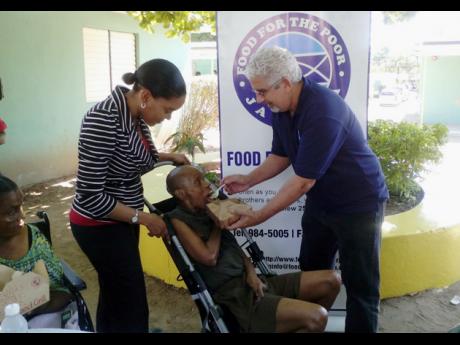
Executive Director of Food For The Poor (FFP) Jamaica David Mair (right), feeds a resident of the Golden Age Home during the Christmas Treat hosted by his charity organisation recently. Sharing in the moment is Mishka Townsend-Brown, assistant general manager, Golden Age Home. Approximately 150 residents were fed and treated with care packages by FFP Jamaica. The treat for the elderly at the Golden Age Home was one of several treats held by FFP Jamaica to commemorate the festive Christmas season last year.

ffp1

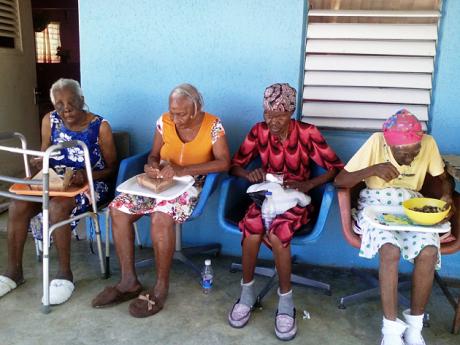
Residents of the Golden Age Home enjoy their lunch provided by members of Food For The Poor during their annual Christmas Treat.

Source: http://jamaica-gleaner.com/article/news/20170112/food-poor-brings-joy-golden-agers

FFP TRAINS 50 STUDENTS AT SUMMER BAND CAMP

0000892
Executive Director of Food for the Poor (FFP) Jamaica David Mair (right) engages in conversation with a student and parent who participated in the annual summer band programme. Band Director Jeffrey Brown and Sandra Ramsey (2nd left) FFP prison ministry administrator, look on .

THREE weeks and 16 lessons, that’s what it took for Food For The Poor(FFP) Jamaica’s Annual Summer Band Camp programme to transform 50 students from musical novices to trained musicians, after playing instruments of their choice.

The participants were trained to use drums, saxophones, flutes, trumpets, clarinets and trombones between July 18 and August 11 at the summer band camp, which was held at FFP’s headquarters in Ellerslie Pen, St Catherine.

David Mair, executive director at FFP, said the band camp, which is in its eighth year, was an important initiative for the charity organisation.

“The annual band camp is a very special aspect of our ministry here at Food For The Poor and one that is anticipated by both the participants and FFP staff. Music unifies us so every year we look forward to hosting the children and celebrating with them during their graduation,” said Mair.

He added: “Another amazing aspect of this programme, which we fully endorse, is the fact that past students actually return to assist and they also serve as an inspiration to the new crop of students.”

Attendees at the awards ceremony, which included several proud parents, were treated to multiple music pieces which the participants learnt over the three weeks. One proud parent, Sharonette Walker, whose son Nathan has been participating in the camp for two consecutive years, sang nothing but praises for the musical programme.

“For the past two years, I have been assisting with the programme in terms of monitoring the students. It has been an inspiring journey because you see the growth these students experience and how much they love what they do,” she stated.

During the graduation ceremony held on August 11, the participants were filled with much excitement upon receiving the news that they would be awarded with the instruments they used during the camp.

Band campers Christeena Henry and Daniel Myers expressed gratitude to band camp organiser and administrator for the prison ministry department, Sandra Ramsay, as well as music instructor Jeffrey Brown.

“We couldn’t have done this in three weeks without the dedication of Mrs Ramsey and Mr Brown. They constantly pushed us to be better even when we didn’t see it for ourselves,” they said.

Ramsey announced that on the last Saturday of each month, the 50 youngsters can return to the grounds of Food For The Poor to practice and better develop their musical talents and skills. They will also be given the opportunity to learn other musical instruments.

This year, Food For The Poor’s Summer Band Camp hosted students between six and 16 years of age. Since the programme started eight years ago, more than 200 participants have been trained.

Source: http://www.jamaicaobserver.com/news/FFP-trains-50-students-at-summer-band-camp_71463