All well-thinking Jamaicans welcomed the creation of Independent Commission of Investigations (Indecom), which ensures that the security forces remain professional and ethical. In every organisation you will find the few who ‘let down the side’, and it is important that they be brought to justice.
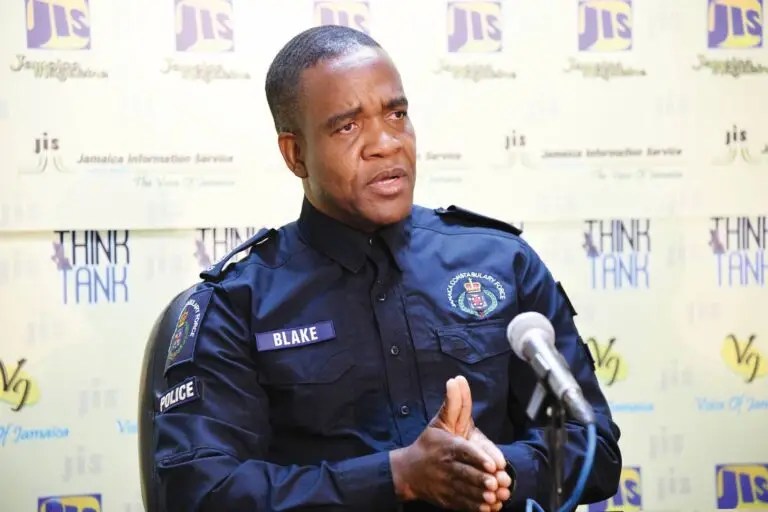
I must, therefore, quote at length Police Commissioner Dr Kevin Blake’s response as shared by Jamaica Observer Editor-at-Large Arthur Hall in a report headlined ‘No Apology — Police commissioner slams JFJ; says criminals to be blamed for 50 fatal shootings in 50 days by security forces’.
Commissioner Blake is reported to have said that “….while he supports the view that the number of fatal shootings by the security forces is too high, the focus should be on the criminals who make the decision to challenge members of the Jamaica Constabulary Force [JCF], ‘which is a far more superior force’.”
Hall reported: “He charged that a call for the JCF to be held more accountable is a slap in the face of Indecom, which has a single most important mandate of investigating actions against civilians by members of the security forces.”
Here are excerpts from the commissioner’s response, as quoted by Hall:
“And so, let me encourage Jamaicans for Justice to be more responsible in their public pronouncements, especially when the nation is aware of its members’ proven ability to comprehend the most basic and fundamental principles of security.
“To suggest that fatal shootings numbers can be reduced by anything other than the unwillingness of persons being apprehended to engage in deadly confrontations with members of the security forces is irresponsible, or at best advocating for us to relent in our pursuit,” added Blake.
“He declared that criminals who are intent on killing and maiming will not be left free to hold communities at ransom and in constant fear,” wrote Hall.
That Savanna-la-Mar earthquake in the late 1950s was a frightening one for me as a small child. I was in the house behind the shop run by our widowed mother. As I felt the place shaking, I ran out into the dark street. A light flashed on red-seamed trousers. Because the police always cast a protective eye on our shop, I knew I would be safe if I grabbed on to that red-seamed trousers leg. The police officer picked me up, took a look, and recognised me as “Mrs Singh’s little girl”. He walked swiftly to the shop and handed me to my mother.
Many years later, on assignment at Caymanas Park in the 80s, I would have long conversations with officers Williams and Whitney. They would always arrive impeccably dressed and were thoroughly professional. Some mornings they would share that they had been in operations the night before, dodging bullets.
In the 90s I collaborated with Lasco to create the Police Officer of the Year Award and met some of the most inspiring officers. Some of the organisers were Assistant Commissioner of Police (ACP) Neville Wheatle, Senior Superintendent of Police (SSP) LK Simpson, and a young constable who is now Deputy Superintendent of Police (DSP) Natalie Palmer-Mair. Interestingly, the first Police Officer of the Year was retired Assistant Commissioner of Police Steve McGregor, who is now a politician.
After the 2002 General Election, which had been monitored by representatives of the Carter Centre, they reported that the Jamaica Constabulary Force (JCF), led by then Commissioner Francis Forbes, had been exemplary in its work, as were the Electoral Office of Jamaica (EOJ) personnel. They declared that there would be no reason for them to monitor any further elections in Jamaica.
In other projects, I have seen the courage of SSP Ionie Ramsey Nelson, the brilliance of retired DCP Novelette Grant, SSP Stephanie Lindsay, and the compassion of Sergeant Jerr Johnson-Heron who has assisted with distributing care packages for the elderly on behalf of our seniors advocacy organisation. Indeed, the police youth club is the largest youth club in Jamaica and the Law Enforcement Torch Run has earned millions of dollars over several decades for Jamaica’s Special Olympians.
It is, therefore, deeply concerning that our outstanding JCF appears to be under unrelenting attack by the organisation Jamaicans for Justice (JFJ). I am confounded that the current head of the JFJ seems to be unaware of the dangers our police face in their crime-fighting efforts.
Jamaica was recently hit by a magnitude-5.6 earthquake.
As we continued to feel phantom quakes after last week’s earthquake, that anxiety reminded me of stories from dwellers in our inner-city communities. “Miss Chin,” said one lady, “is under the bed mi hide with mi grandson last night. You should hear the shot them. I still trembling.” Said another, “I was at the bus stop and I heard the shots coming nearer. I had to run and hide around the corner. All now mi heart still beating fast.” These are hard-working middle-aged women who work, worship, and nurture their families. Surely they deserve better than this.
So, yes, we may have had some fearful days and nights last week, but members of our Jamaican family have been living that fear for decades — day in, day out. They cannot cross certain streets as that may take them into enemy territory. When violence happens close to them, they have to “see and blind, hear and deaf” so they are not branded as informers and attacked.
There must be some super-sized hypocrites in this country for barefooted boys to have access to dangerous weapons and for the number of gangs in this tiny rock to exceed 250. We are hearing talk of the ‘El Salvador model’ and the retraining of our police. It is the police who must be mentoring our youth in the Police Youth Club, the largest in Jamaica. How about our politicians launching mentorship programmes in their constituencies and bringing the parish councillors on board. HEART/NSTA Trust offers free training, but how many youth are being guided in choosing a vocation, signing up for the classes, and sticking with the training to get certified?
Project STAR, brainchild of Keith Duncan and his Private Sector Organisation of Jamaica (PSOJ) colleagues, has been seeing more young people trained and getting employment. The Ministry of Education has launched parenting programmes, urgently needed as increasingly schoolchildren are displaying violent behaviour. Church groups have been expressing their fears of antisocial behaviour in schools and our unattached youth are easy prey for gang leaders.
Crime continues to sap our economy. Businesses must spend heavily on security and scheduled surgeries must make way for gunshot victims. The crazy driving by taxis may be caused by their desperate effort to make enough money to pay themselves as well as the extortionists. There can be no finger-pointing by one political party at the other, they are both accountable for this distressing situation.
Some of us can afford the guards, gates, dogs, electronics to keep us secure. Our poor can afford none of this. Please, let this criminal quake stop shaking up their lives.
Calls for preparedness
We are giving thanks that there were no injuries and minimal damage after the magnitude-5.6 earthquake which was heavier in our eastern parishes. In contrast, the same strength earthquake in Nepal over the past weekend has caused some 150 deaths and widespread destruction. Our building codes may have served us well, but the 2010 earthquake which took 300,000 Haitian lives is a reminder that both our countries are located on the Enriquillo–Plantain Garden fault zone (EPGFZ or EPGZ). According to Wikipedia, this is “a system of active coaxial left lateral-moving strike slip faults which runs along the southern side of the island of Hispaniola, where Haiti and the Dominican Republic are located. The EPGFZ is named for Lake Enriquillo in the Dominican Republic where the fault zone emerges and extends across the southern portion of Hispaniola through the Caribbean to the region of the Plantain Garden River in Jamaica.”
This is the system which caused the submersion of the larger part of Port Royal in 1692, taking a total of 5,000 lives and the destruction of 80 per cent of the buildings in Kingston in 1907, causing nearly 1,000 deaths.
“The ramifications of such sudden disruptions are widespread, significantly impacting the private sector through the cessation of business operations, damage to assets, and inventory losses,” noted the PSOJ in a statement. “The resulting strain extends to the insurance sector, evident in an upsurge of claims and the inevitable increase in insurance premiums. Additionally, the landscape of development financing is altered, introducing a realm of uncertainty for investors.”
It continued, “The IDB Disaster Risk Profile for Jamaica published in 2020 estimated that buildings and infrastructure in the country are vulnerable to seismic activity, with a total exposed value of US$44.5 billion. This means that in the event of an apocalyptic 1000-year event, the probable maximum loss is US$3.7 billion, representing 8.2 per cent of the total exposure.”
The organisation called for “heightened rigour in enforcing building codes, conducting building inspections, and executing earthquake drills. This becomes even more pertinent as we witness a transformation in our development landscape, characterised by increasing building heights and densities.”
It is said that “to be forewarned is to be forearmed”. The US Federal Emergency Management Agency (FEMA) has useful tips on its website, including the preparation of a “go-bag” for emergencies. Please get this done, but keep it compact as it should fit on your lap to save space in case of an emergency extraction.
That heavy shake should focus us wonderfully on taking precautions for personal and national safety.
JA Sign Language Bible
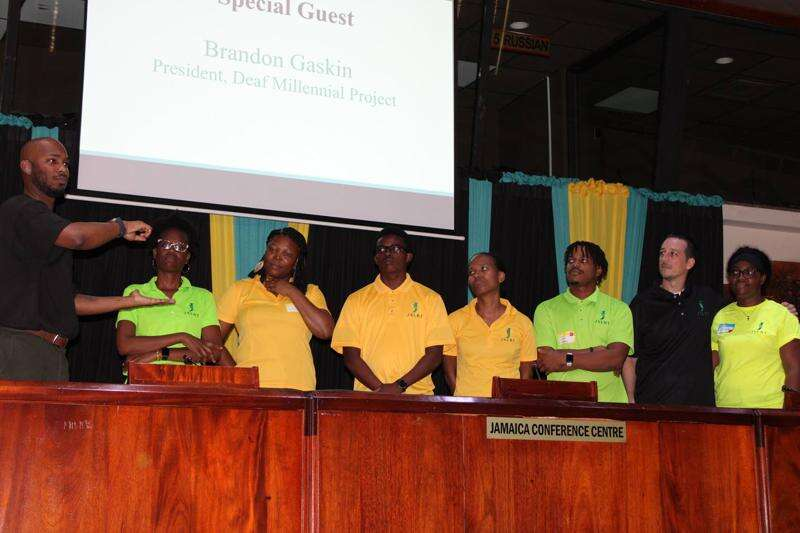
Special guest Brandon Gaskin (left) prays for the JSL Bible Translation team (from second left) Sheree Henry, Zandrea Pitterson, Damion Stewart, Tashi Widmer, Clifton Blackellar, Blake Widmer, and Francine Richards.
The Jamaican deaf community gathered at the Jamaica Conference Centre in downtown Kingston recently to celebrate the launch of the JamaicanSign Language (JSL) Bible Translation, spearheaded by Tashi and Blake Widmer.
Community members from across the island came together to learn about and celebrate another beginning in God’s ongoing work among the deaf of Jamaica.
Participation came from local deaf schools and churches — from Wycliffe Caribbean and even the global sign language translation team from SIL, a global, faith-based nonprofit that works with local communities around the world to develop language solutions. The endeavour was launched with the theme ‘God’s word made alive in JSL’.
Renca Dunn, a veteran Bible translator for the American Sign Language (ASL) Bible, reminded the audience that Bible translation is not easy, yet God provides what we ask for. Matt Knapp of HarvestCall and Zandrea Pitterson, one of the translators, exhorted the audience to focus on knowing God and making Him known. There were songs, dramatic presentations, and Bible stories shared, young and old coming together as one, including Jamaican Country Sign.
International guest speaker from Deaf Millennial Project, the founder, Brandon Gaskin inspired the audience and encouraged all to think and dream about what God could and would do in and through this ministry. Special communal prayer was offered on the JSLBT staff and engaged the whole audience in coming together and praying that God would sustain and add the increase as they begin training and research.
With the support of Krystal Clear Productions, the launch was also streamed on Zoom to the Diaspora. Danya’s Coffee Barrel provided delicious fare. With volunteers happy to serve, it all came together as a well-executed, encouraging, and uplifting event, glorifying God and the beginning of something fruitful and beautiful — God’s word brought to life in Jamaican Sign Language.


 Jamaica Highlights