Mt Alvernia High gets new STEM classrooms, solar generator

Maria Santamarina (centre), Food For The Poor’s director of government programmes, and Kayon Whyne (right), principal of Mt Alvernia High School in Montego Bay, St James, take part in a ribbon-cutting exercise during the inauguration ceremony for two ren
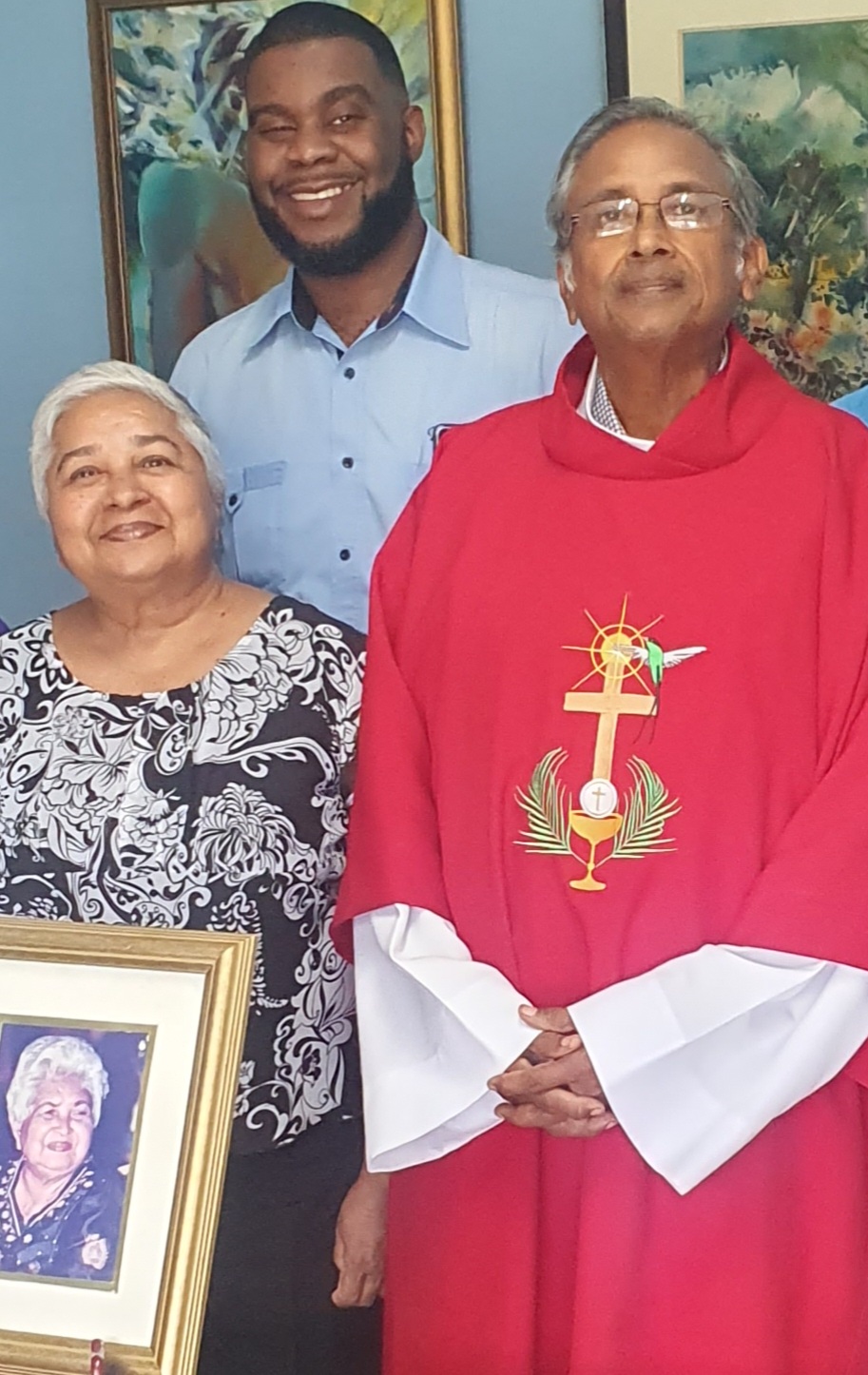
Maria Santamarina (centre), Food For The Poor’s director of government programmes, and Kayon Whyne (right), principal of Mt Alvernia High School in Montego Bay, St James, take part in a ribbon-cutting exercise during the inauguration ceremony for two renovated classrooms for physics and chemistry and the installation of a solar-power generator at the school, on Thursday. Also pictured (from left) are Dr Horace Chang, minister of national security and member of parliament for St James North West; Doreth Chambers, chairman of the Mt Alvernia High School board; and Reverend Kenneth Richards, Roman Catholic Archbishop of Kingston.

WESTERN BUREAU:

MOUNT ALVERNIA High School in Montego Bay, St James, has increased its capacity to train its student cohort in mastering the science, technology, engineering and mathematics (STEM) curriculum, following the official inauguration of two renovated classrooms and installation of a solar-power generator at the school.

The classrooms, which will be used for physics and chemistry classes, and the generator, which will be used to power the entire campus, were presented to the school through Food For the Poor [FFTP] and the USAID’s American Schools and Hospitals Abroad [ASHA] programme, at a cost of J$155 million.

During the hand-over ceremony at the school, Maria Santamarina, FFTP’s director of government programmes, noted that the new STEM facilities will allow the school to help bridge the current global gender gap in educational opportunities.

“Although some countries have achieved gender equity in access to education, the results have not led to equal life outcomes for women. In other words, simply giving girls access to education is quite frankly not enough, and one possible solution lies in STEM,” said Santamarina.

“A strong foundation in STEM provides girls with unique skill sets that build their ability to be creative and global problem-solvers. These USAID-funded projects will allow Mt Alvernia High to have a sustainable STEM programme that will promote the advancement of girls’ education in science and technology, resulting in employment in these fields, especially in Jamaica where STEM is still male dominated,” Santamarina added.

According to data from the American Association of University Women, currently women make up only 28 per cent of the workforce in STEM-related fields globally.

In February 2022, Education and Youth Minister Fayval Williams suggested that the achievements of women in STEM fields should get more emphasis in order to inspire more girls to bridge the gender gap and upend gender stereotypes associated with the profession.

At that time, Minister of Science, Energy and Technology Daryl Vaz promised that the government would continue to provide the necessary support to help girls and young women harness their skills in STEM subjects.

In the meantime, Doreth Chambers, the chairman of Mt Alvernia High School board, thanked FFTP and USAID for the renovated classrooms and the donated solar generator, which will benefit the school’s 1,400 students.

“We are delighted that Mt Alvernia High School has benefitted from the collective efforts of two philanthropic organisations, and we are heartened that you all are here to share in the dedication of their vision coming alive. The core values, the mandate, the generosity, and the synergy of these two benevolent associations produced a bountiful harvest, and from the start they made the process smooth, being always knowledgeable, clear, receptive, and goal-oriented,” said Chambers.

Source: Jamaica Gleaner | Mt Alvernia High gets new STEM classrooms, solar generator

Get involved in your children’s lives, urges Digicel Foundation CEO

Grade-five students at Alpha Primary School listening as Digicel Foundation Chairperson Jean Lowrie-Chin reads a book about Queen Esther to them on Read Across Jamaica Day on Tuesday. Digicel Foundation volunteers, board directors, and Digicel’s senior management team read and interacted with students at four schools. In addition to a donation of books and STEM kits, the foundation has committed $600,000 to be split equally among the schools.

CEO of the Digicel Foundation Charmaine Daniels is urging Jamaican parents to get even more involved in the lives of their children.

“I firmly believe that children are the future of our nation. This year’s theme for Child Month, ‘Children need our love and protection…Get involved,’ resonates deeply with us at the foundation.

“We have always been committed to supporting initiatives that promote the well-being of children in Jamaica, and this year, we are more determined than ever to inspire others to do the same,” said Daniels in a letter to the Jamaica Observer.

“As the first point of contact for children, adults play a crucial role in creating a safe and nurturing environment for our young ones. We must provide the necessary support for our children’s mental, emotional, and social well-being.

DANIELS…children are our future and we need to listen to them

“At the Digicel Foundation we have remained focused on our most vulnerable children, partnering with the Ministry of Education and Youth and the Early Childhood Commission to strengthen the infrastructure needed for enhanced learning for our younger students, especially in rural areas; and through support for children with special needs,” added Daniels.

She pointed to figures provided by Latoya Minott-Hall, public education and special projects manager at the Office of the Children’s Advocate, in February, which showed that more than 2,300 children and teens have accessed ‘SafeSpot’, a 24-hour helpline for children supported by the Digicel Foundation.

This data highlights the need for us to be more active and present in the lives of our children, particularly during these challenging times,” declared Daniels.

The Digicel Foundation head underscored that children have the right to be heard.

“As I recently discussed…there is a difference between active listening and passive listening. We must actively listen to our children, to truly hear what they say. When we listen to our children, we understand them better.

“At the Digicel Foundation, we have always recognised the importance of children’s voices being heard. We have supported numerous initiatives that empower children and provide them with opportunities to express themselves, including facilitating workshops for parents, caregivers and children with disabilities,” added Daniels.

She charged that parents can get involved in the lives of their children’s in many ways, including attending parent-teacher association meetings, assisting them with their homework, or just reading to them.

“One of the simplest yet most effective ways to get involved is by reading with our children. Reading not only helps build a bond between us and our children, but it also makes reading a habit that will benefit them in the future. On Read Across Jamaica Day, the Digicel team went out to schools and connected with the students through some of their favourite books!

“Creating a safe environment for our children is essential. Children are valuable in building a better Jamaica, a place of choice to live, work, raise families, and do business. We have a high duty of care to love and protect them. When our children feel protected and safe, they feel that we truly love them,” said Daniels.

JPS owners Marubeni hold discussions with Jamaican Gov’t, private sector

Light Conversation: President of the Private Sector Organisation of Jamaica Mr Metry Seaga (4th from left) and Executive Director Mrs Imega Breese McNab (5th from left) hosted a visit by Marubeni Power International recently. The visitors were (l-r) Mr Damian Obiglio, Senior Vice-President for Caribbean Operations at Marubeni Power International, Mr. Ryota Kobayashi, General Manager, Overseas Power Dept-2, Marubeni Corporation, Mr. Yuji Sato, Senior Operating Officer, Power Division, Marubeni Corporation, Mr Mohamed Majeed, Chairman, South Jamaica Power Company (SJPC) & CEO, Marubeni Caribbean Power Company and Mr Keisuke Harada, Senior Manager, Caribbean Operations at Marubeni Power International. The team discussed a range of issues affecting companies in the manufacturing and other commercial sectors in Jamaica today and the potential for knowledge-sharing by Marubeni with the Jamaican private sector. (Photo: Contributed)

Senior executives from Japan-based Marubeni Power International made a series of visits with Government and private sector representatives recently, aligned with the observance of the 100th anniversary of Jamaica Public Service Company (JPS).

The visits included Prime Minister Andrew Holness and Foreign Affairs Minister Kamina Johnson Smith, with Marubeni executives also engaging with Metry Seaga, president of the Private Sector Organisation of Jamaica (PSOJ) and its executive director Imega Breese McNab.

The Marubeni team, comprising high-ranking officials were said to have held productive discussions on various key topics. 

Minister Johnson Smith noted on social media, “We discussed Marubeni’s global work in renewables and #GreenTransition, as well as the correlation between #SustainableDevelopment, private sector investments and social cohesion.”

In addition, Johnson Smith highlighted the significance of their investment and emphasised the crucial role of corporate social responsibility, particularly in the aftermath of the COVID-19 pandemic.

One of the central areas of focus at the PSOJ meeting was the cost of electricity supply to the commercial sector, considering Marubeni’s substantial investments to increase available capacity while minimising its carbon footprint.

President of the Private Sector Organisation of Jamaica Mr Metry Seaga (4th from left) and Executive Director Mrs Imega Breese McNab (5th from left) hosted a visit by Marubeni Power International recently. The visitors were (l-r) Mr Damian Obiglio, Senior Vice-President for Caribbean Operations at Marubeni Power International, Mr. Ryota Kobayashi, General Manager, Overseas Power Dept-2, Marubeni Corporation, Mr. Yuji Sato, Senior Operating Officer, Power Division, Marubeni Corporation, Mr Mohamed Majeed, Chairman, South Jamaica Power Company (SJPC) & CEO, Marubeni Caribbean Power Company and Mr Keisuke Harada, Senior Manager, Caribbean Operations at Marubeni Power International. The team discussed a range of issues affecting companies in the manufacturing and other commercial sectors in Jamaica today and the potential for knowledge-sharing by Marubeni with the Jamaican private sector. (Photo: Contributed)

Notably, the discussions highlighted the progress made at the South Jamaica Power Company (SJPC) plant in Old Harbour, St Catherine.

In addition to energy-related matters, the meetings covered the business environment for manufacturing and industrial companies in Jamaica. The Marubeni representatives also explored opportunities to incorporate emerging technologies into the Jamaican landscape, leveraging the company’s extensive global operating expertise for the benefit of the Jamaican economy.

Marubeni Corporation, founded in 1858, is one of the largest Japanese industrial conglomerates, with interests in commodities trading in addition to its strong electrical and industrial plant businesses. 

Best Care Special Education School targets self-sufficiency

Geneva Cooper (second left), vocational and farming teacher, Best Care Special Education School, discusses the different crops planted on the farm and in the shade house at the school with (from left) Julian Robinson, member of parliament for St Andrew South Eastern; Marsha Smith, minister of state in the Ministry of Education and Youth; Pat Reid, past president of the St Andrew Junior Chamber; and Lorna Mae Welsh, principal, Best Care Special Education School. The occasion was an opening ceremony of the Farm and Shade House Project at the School on Wednesday.

IN ENSURING that the Best Care Special Education School in Kingston becomes self-sufficient, administrators have already looked towards expanding its recently established vegetable farm and shade-house project.

Speaking with The Gleaner at Wednesday’s launch of the project, Geneva Cooper, farming and vocational class teacher, stated that the first set of crops reaped from the farm were bountiful and that the aim is for the farm to eventually be able to supply the school’s cafeteria.

The farm, she said, currently consists of cucumbers, Scotch bonnet peppers, tomatoes, lettuce, and callaloo, among other crops. The next step, she said, was to evaluate how the institution could make efficient use of its limited space for farming activities so as to maximise operations and also to delve into hydroponic farming.

The project was executed by the Kiwanis Club of Constant Spring in partnership with Food For the Poor, St Andrew Junior Chamber, and the Jamaica Agricultural Society with funding from the Environmental Foundation of Jamaica, and the Forestry Department.

Cooper explained that students were the ones who tilled the soil, sow the seeds and cared for the seedlings, which were then transplanted into pots and on the farm. The potted plants were being sold to community members along with vegetable seedlings in order to generate additional income.

“We have the capacity to basically sow and produce over 4,000 seedlings or higher per month from this greenhouse. In fact, the RADA (Rural Agricultural Development Authority) extension officer told me that we can have more than 10,000 seedlings per month being generated,” she said.

HOLISTIC DEVELOPMENT

The institution, which has been operating independently since 2017, caters to 165 students aged six to 21 years.

“We are looking at holistic development of the students, and if possible, having students use this as an income earner for themselves later on in life. You know students with disabilities are disenfranchised in many capacities, and if they can use farming as a tool, as a way of enhancing themselves, we want to provide them with that kind of option,” she said.

During his remarks, chairman Orville Johnson also expressed his vision of expanding the project, detailing that building upwards was a more efficient way for it to be executed.

“We go right up and produce about five floors … . I’ve seen some stuff now in China with 24-floor buildings that are farms, so the area is not a restriction anymore … we can [grow upwards], so the possibilities are great,” he said.

This was not the first time that the school had tried its hands at establishing a farm on its grounds, but after facing water issues for many years, it could not have been executed, Johnson revealed.

Through the institution’s water-harvesting programme, with catchment facilities of a holding capacity of 22,000 gallons of water, the water woes have been alleviated.

“It has come in pretty handy, and what we need to do now is to expand because we have found out that we need to do a little bit more now,” he explained.

State minister in the Ministry of Education and Youth, Marsha Smith, who was also in attendance, stated that the ministry recognised that administrators at the institution have made a “meaningful impact” in the lives of Jamaicans with special needs.

Smith expressed delight in being able to witness the agricultural aspect of education taking place as “emphasis on school gardens is an important part of the ministry’s approach to nutrition policy”, she said.

Source: Jamaica Gleaner | Best Care Special Education School targets self-sufficiency

CIBC FIRSTCARIBBEAN, CCRP, TAKE DIGITAL BANKING TO SENIORS

Four lucky attendees of the CIBC Firstcaribbean and Caribbean Community of Retired Persons (CCRP) “Tech Talk” Digital Banking and You webinar, were presented with tokens of appreciation for their participation during a visit to the bank’s Knutsford Boulevard, Kingston headquarters on May 25, 2023. Here Owen Francis (centre), Director Retail Banking Channels, CIBC Firstcaribbean is flanked by (l-r) Dwyneth Mclaughlin, Ina Crooks, Marcia Dean and Jeneita Townsend.

CIBC Firstcaribbean senior customers and members of the Caribbean Community of Retired Persons (CCRP) recently participated in “Tech Talk”, a virtual webinar hosted by the bank to educate and sensitize persons 40 years and over on the benefits of using its digital banking channels.

The webinar, explored a range of topics including cyber security, online banking and mobile Apps, Smart ABMS capabilities and special benefits such as the CIBC Firstcaribbean Seniors Savings which offers interest rates on all credit balances above the threshold and a range of free services including transactions at Instant Tellers and no monthly service charges.

Owen Francis, Director Retail Banking Channels, CIBC Firstcaribbean, told participants that the bank was particularly appreciative of the opportunity to speak directly to its senior customers and CCRP members to apprise them of the very special products and services some of which were curated especially for them.

He said that “CIBC Firstcaribbean prides itself on giving our clients the privileges they deserve including, personalized and secure banking. Our customers know that we offer quality service, convenience, flexibility and accessibility to our suite of banking solutions”.

Mr. Francis said that “Tech Talk” was part of the bank’s efforts to help our clients to simplify their banking experience as they navigate our digital banking channels.

“We are intent on increasing your knowledge, skills and confidence to make responsible financial decisions as you manage your financial affairs and this webinar will improve your understanding of benefits offered by our bank and ensure you know how to access resources and support appropriate to your circumstances”, he told participants.

Pointing to changing needs of older customers Mr Francis said that “it is clear to CIBC Firstcaribbean that we are living longer and having greater responsibility for funding our retirement, so saving and building a personal ‘nest egg’ for the future are more important than ever.”

Expanding, Mr Francis said “Our senior population in Jamaica is diverse – at different ages, income levels, education, health, personal and family circumstances. So clearly, our bank’s approach is not a one size fits all. However, from our experience and research we know that everyone needs and appreciates guidance on how to efficiently conduct their banking business.”

Source: Jamaica Observer | CIBC FIRSTCARIBBEAN, CCRP, TAKE DIGITAL BANKING TO SENIORS

We had better wake up to the issue of ageing in Jamaica

Jean Lowrie-Chin

Mrs Jean Lowrie-Chin, who Jamaicans will call blessed for her work with the Caribbean Community of Retired Persons (CCRP), hit the nail squarely on the head in her very helpful column in this newspaper.

“As hard as it is on Jamaicans to hear news of crime and violence, it is even worse for our elderly, especially those in violence-prone communities.

“Many suffer from underlying medical issues and disabilities and so the saying, ‘You can’t run, you can’t hide’ applies to them, literally. Besides that, abuse of the elderly is not only one of the most cruel and silent crimes in Jamaica, but also worldwide,” she wrote.

It is hard not feel a sense of remorse when one sees how senior citizens exist in Jamaica, generally speaking. The squalor bred by poverty that is the lot of too many in the rural parts is ugly and stomach-turning.

Add to that food security, inadequate access to specialised geriatric care, the high levels of violence and elder abuse pointed out by Mrs Lowrie Chin, and low levels of social security that expose them to sexual assaults and robbery.

There was once a popular view that one could judge the civilisation of a society by the way it treats its senior citizens, respecting them for their presumed experience, wisdom, and maturity. That appears to be a view of the past.

But Jamaica had better wake up to the reality that the country’s population is rapidly ageing. Our own Planning Institute of Jamaica insists that the population is becoming top heavy, with the elderly population — that is people aged 65 and over — expected to double by 2050, when they will constitute almost 20 per cent of the total population.

So, like the rest of the world, Jamaica will face the fact that an ageing population holds significant implications, such as will be immediately felt in labour market shortages and in the inadequacy of pension plans. That is in the short term and not somewhere off into the distant future.

In the latest revision of the National Policy for Senior Citizens, the state of the country’s aged is fairly accurately assessed and solutions to the challenges proposed through a multi-stakeholder approach designed to address social, economic and health barriers. We, of course, were dismayed to learn that only 23 per cent of the elderly have health insurance.

The stark reality is that the Government is doing almost as much as it can, given the limited resources, through programmes like the Jamaica Drugs for the Elderly, the National Health Fund, the National Insurance Scheme, the National Committee for Senior Citizens, and several others.

But a lot more will be necessary before we can hold our heads high about our treatment of the elderly.

The talk about forcing children to be responsible for their elderly parents is too thorny an issue to be relied on as a workable solution.

We might need to consider a two per cent tax on salaries above $10 million a year to build more infirmaries and assisted living facilities, increase social pension benefits, expand feeding programmes, subsidise transportation, and monitor private nursing homes, many of which are a putrid excuse for such.

This kind of tax will recognise the importance of tackling the problem as a national one and should be considered, even if it means putting it to a referendum.

Source: Jamaica Observer | We had better wake up to the issue of ageing in Jamaica

Jamaica, Farewell

Excerpt from the Jamaica Observer column published on Monday, May 1, 2023

By Jean Lowrie-Chin

Dr Annette Alexis (fourth left) with members of the Stella Maris Steel Band

In the 1970s we journeyed to his mother’s hometown Aboukir in St Ann, where Harry Belafonte performed. Tickets were the princely sum of $2. He laced his ringing songs with activist messaging, reminding us that we all need to use the voice God gave us.

In the 1990s he performed at a fund-raiser for the Jamaica Medical Foundation and we organised a press briefing at the then Blue Cross conference room. His charisma filled the room, and he wowed us with a few bars of Day-O. His performance at Jamaica House was rich with humour. One line I remember was, “People ask me how I keep so young. I don’t know, but my friend Sidney Poitier drinks Oil of Olay.”

We should know that Harry Belafonte was the first-ever singer (black or any other colour) to score a gold record, which he did for his album Calypso; that he paid the bail for Dr Martin Luther King Jr (MLK) to be freed from the Birmingham jail; that his mother was a strong Garveyite; and that he took his white friends in entertainment to hear MLK’s ‘I Have A Dream’ speech. May his great soul rest in peace.

We in Jamaica were blessed when Grenadian-born Dr Annette Alexis made her home here. Dr Alexis was one of the longest-serving directors of the Stella Maris Foundation, giving free eye care to the less fortunate at her Parkington Clinic and as a volunteer at the Foundation for International Self Help Development (FISH Clinic). Dr Alexis was a prayer warrior, always with rosary in hand, and a talented member of the Stella Maris Steelband.

Dr Alexis’s heartbeats were her son Dr Shane Alexis, past president of the Medical Association of Jamaica, and her two granddaughters. The University of the West Indies Seacolite was a cycling buff and had a fabulous sense of humour, which was matched by her radiant smile.

Our Stella Maris family is heartbroken at her passing, but we know all is well with her beautiful soul.

Our deepest sympathy to Shane and the other family members here and in Grenada.

Kudos Andrea Orelue

Excerpt from the Jamaica Observer column published on Monday, May 1, 2023

By Jean Lowrie-Chin

You may know her on social media as Andi O, a hilarious commentator. But this is just the way Orelue lets off steam when she is under pressure at the Government Laboratory in downtown Kingston. During the COVID-19 pandemic, she shared with us her sleepless nights as she and her dedicated team collated results islandwide so we could keep track of the numbers.

In observance of Medical Laboratory Professionals Week, the Ministry of Health and Wellness presented several awards, the highest of which went to Orelue. Ironically, while there were photos of the awards ceremony, she had too much work to attend and, therefore, the trophies were taken to her.

The MOHW posted, “It’s a big deal. The Director’s Award goes to @Andi_O. Among the criteria … having a reputation for ethical practice when dealing with the public and demonstrating a track record of mentorship of young professionals within the laboratory field.” We are grateful for your service, Andi, congratulations!

Minister Samuda at SJPC

Excerpt from Jamaica Observer column published on Monday, May 1, 2023

By Jean Lowrie-Chin

JIS Photo

Minister without portfolio in the Ministry of Economic Growth and Job Creation, Senator Hon. Matthew Samuda (Center) being briefed about operations and features of the South Jamaica Power Company plant by Chairman, Mohammed Majeed (left) during a recent tour of the facility in Old Harbour St. Catherine. Also seen here are Plant Manager, Noel Watson (right) and General Manager, Leisa Batiste whyte (in the background).

Acknowledging his keen concern for the environment, my colleagues at the South Jamaica Power Company (SJPC) were pleased to welcome Minister Matthew Samuda to their energy-saving power plant in Old Harbour last week. The minister’s social media post was heartening.

“Today I met with CEO of Marubeni Caribbean Power Company, Mo Majeed, and his team as well as representatives from the @myjpsonline and toured the South Jamaica Power Company today to seek avenues for partnership in the clean energy sector. Currently, in Jamaica, Marubeni operates a liquefied natural gas (LNG) facility in Old Harbour, St Catherine, which has cut emissions by 30 per cent from this plant. From this meeting and tour I saw possibilities for clean energy solutions that will lower consumer energy bills, create ‘clean’ jobs, and build our economy, which can be achieved by accelerating the use of energy-efficient resources, renewable energy, and electric vehicles. “

Prior to the tour of the facility, Plant Manager Noel Watson and General Manager Leisa Batiste-Whyte gave a brief overview of the operation, highlighting key features of the world-class facility which is owned by Marubeni, East West Power, and the Government of Jamaica. This is yet another sign that Jamaica is on a positive path for a cleaner environment.

‘Domestic workers are workers’

Excerpt from Jamaica Observer column published on Monday, May 1, 2023

By Jean Lowrie-Chin

Prime Minister Andrew Holness (right) presents a plaque to president of the Jamaica Household Workers’ Union and the Caribbean Domestic Workers Network Shirley Pryce at the GraceKennedy/Heather Little-White Household Worker of the Year Award luncheon at the Terra Nova All-Suite Hotel. Sharing the moment is GraceKennedy Group CEO Don Wehby.

he Caribbean Domestic Workers Network (CDWN) chaired by Shirley Pryce reminded us today, International Workers’ Day, that “domestic workers are workers” in its media release.

Somehow, it notes, domestic workers do not enjoy the same rights as other workers, although it points out, “It is because of domestic workers that our societies can function, businesses can run, schools can be open, and doctors at hospitals can take care of the sick. Domestic workers are a critical part of the fabric of our countries!”

Seated beside Prime Minister Andrew Holness at the GraceKennedy (GK) Household Workers Awards event six years ago, Pryce, then president of the Jamaica Household Workers Union (JHWU), briefed him on the International Labour Organization’s Convention 189, which calls for the recognition and protection of the rights and decent work conditions for domestic workers. The PM committed to look into the matter, and soon afterwards Jamaica became one of the four Caribbean countries which has ratified the convention, the other three being Antigua and Barbuda, Grenada, and Guyana.

The CDWN urges governments to have laws ensuring that domestic workers receive “pensions, sick leave benefits, injury benefits, overtime benefits, severance pay, and other social security benefits”. In Jamaica, domestic workers have a right to the benefits of the National Insurance Scheme (NIS) and conscientious employers can assist them in signing up for this and the National Health Fund.

The famous author Malcolm Gladwell wrote about brilliant folks who did not pursue higher education simply because their parents were uneducated and had difficulty navigating scholarship and college opportunities. We should keep check on the opportunities that are available to the children of the household workers in our employment.

I never tire of telling the story of Debbie Williams at the Delves Digicel Headquarters in downtown Kingston. Williams started out as an office attendant and as they noted her efficiency and engaging personality, they decided that she deserved the necessary training to be a receptionist. She aced the job so well that she was asked to be the emcee at one of the company’s anniversary celebrations. This begs the question: Are we encouraging the household workers who serve us to fulfil their potential?

I recall the cheering and dancing of Elaine Duncan’s employer when she was declared a GK Household Worker of the Year in 2015. It was clear that Professor Verene Shepherd was a mentor for Duncan, who last year succeeded Shirley Pryce as president of the JHWU. Among our household workers are some of our noblest Jamaicans, raising their families while supporting ours. Let us show our gratitude by upholding their rights and supporting the advancement of their families.