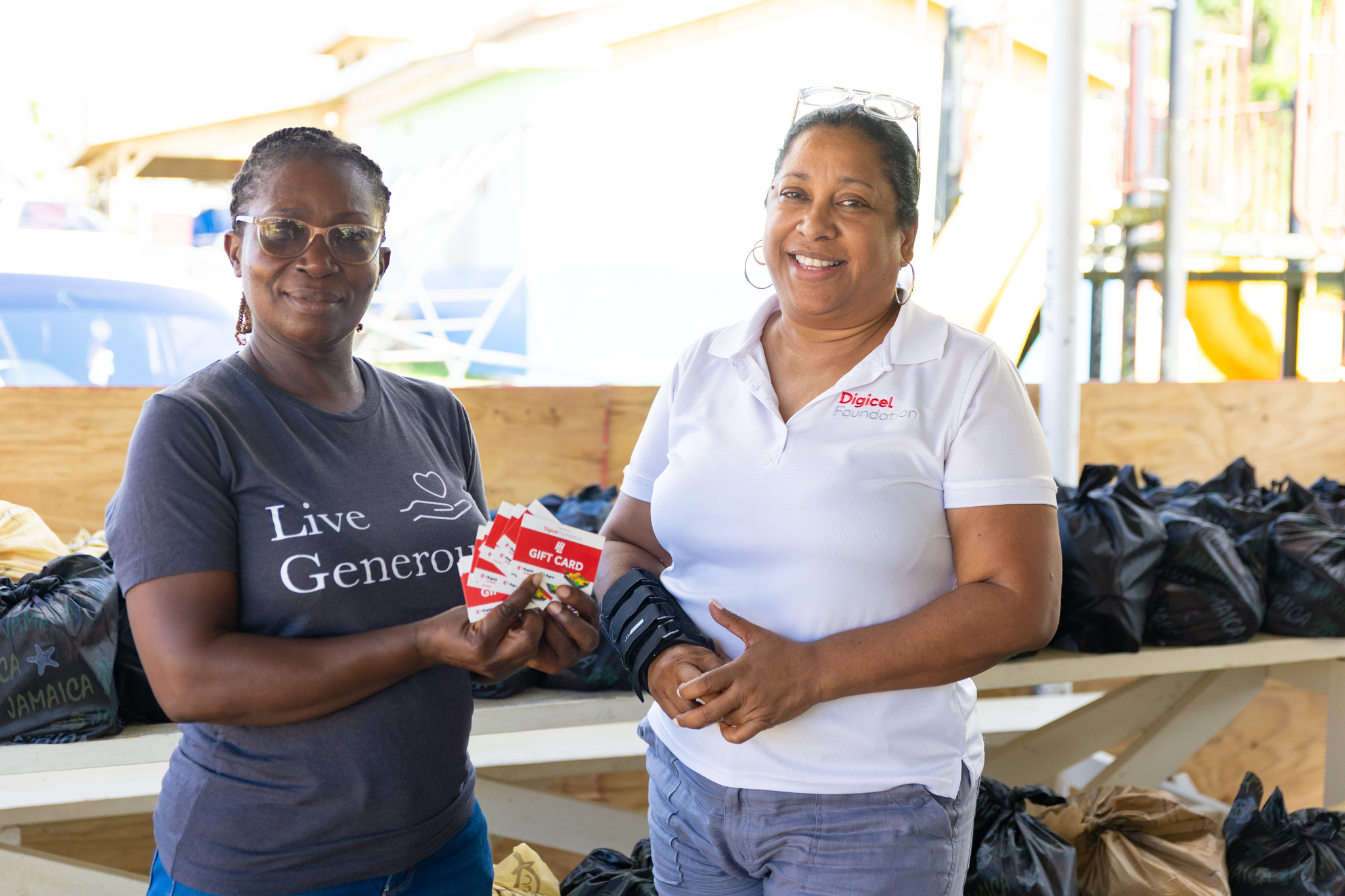
Digicel Foundation CEO Charmaine Daniels (right) hands over $300,000 worth of hardware vouchers to Sadie Brisstell, administrative assistant at West Haven Children’s Home, during a visit to the facility in Hanover.
Throughout the Christmas season, the Digicel Foundation is bringing renewed hope to families impacted by Hurricane Melissa through the distribution of $30 million JMD in Hardware and Lumber Limited vouchers to support home repairs and rebuilding efforts, with a strong focus on western Jamaica, where communities were among the hardest hit. This initiative forms part of the Foundation’s ongoing hurricane relief and recovery programme, which has seen volunteers on the ground weekly, delivering critical assistance to vulnerable families, schools, and special needs institutions since the passage of the storm. “Christmas is a time of hope and togetherness and we wanted to ensure that families who were severely impacted by Hurricane Melissa are not forgotten,” said Charmaine Daniels, CEO of the Digicel Foundation. “These hardware vouchers represent our commitment to helping families restore dignity, safety, and stability as they move forward.” In addition to hardware vouchers, the Digicel Foundation has expanded its care packages to include essential hygiene supplies, such as soap, deodorant, toothpaste, and toothbrushes. The care packages also include solar lights, helping families navigate ongoing power challenges. These enhanced packages continue to be distributed alongside food assistance to communities still facing disruption months after the hurricane. To date, the Foundation’s hurricane relief efforts have reached 35 communities and groups across the island, delivering over 6,000 food packages and more than 900 hygiene packages, with 1,000 hardware vouchers set to be distributed as part of this phase of recovery.
Prime Minister of Jamaica Dr Andrew Holness (left) being greeted by South Africa’s Minister of International Relations and Cooperation Ronald Lamola at the start of the G20 Summit recently.
Prime Minister Dr Andrew Holness commanded international attention as he spoke at session one of the Group of 20 (G20) Leadership Summit in Johannesburg, South Africa, on Saturday. He described our country’s economic progress over recent years, then soberly declared: “Yet one external shock can undo years of progress. Hurricane Melissa, a Category 5 storm, has devastated seven parishes, its impact will negatively affect our debt trajectory and the road ahead will be challenging. This is our reality today. But it is also the recurring story of vulnerability told by small island developing states across Caricom”.
“Global partnerships will be essential to our recovery,” he said. “The G20 commitment in 2021 to recycle SDR [special drawing rights] allocations led to the creation of the IMF [International Monetary Fund] Resilience and Sustainability Trust. This facility provides developing countries with relatively low-cost financing and longer maturities. We urge the G20 to preserve and strengthen this mechanism.”
The rage of Hurricane Melissa was brought on by the warming of our oceans, producing steady 185mph winds and a 252mph wind gust, the highest ever recorded on Earth. Even as our little island is controlling the use of single-use plastics and promoting climate responsibility, we are at the mercy of developed countries whose priorities differ.
Therefore, our prime minister has rightfully appealed for “innovative, flexible financing solutions” and called on the G20 “to advance a rules-based, equitable global trading framework that enhances predictability, flexibility, and resilience for small economies.” The sight of our devastated parishes and suffering people calls for a more compassionate and practical solution for the challenges facing small island developing states like Jamaica.
(L–R) Dr. Kasan Troupe, Permanent Secretary in the Ministry of Education, Skills Youth and Information; Principal of The Mico University College, Dr. Asburn Pinnock; CEO of the Digicel Foundation, Charmaine Daniels; and Digicel Foundation Chair, Joy Clark, cut the ribbon to officially open a Smart Lab at The Mico University College. The lab is the second of five being installed at teachers’ colleges across the island.
The Digicel Foundation has officially handed over two state-of-the-art Smart Labs to St. Joseph’s Teachers’ College and The Mico University College, marking another milestone in its mission to advance education through technology and innovation.
The Smart Labs, each outfitted with 24 laptops and a Mimio-compatible smart board, are part of the Foundation’s commitment to ensuring that teacher training institutions are equipped with modern tools to enhance teaching and learning outcomes. Speaking at the handover ceremony of the Smart Lab at St. Joseph’s Teachers College on Thursday, October 09, 2025, Charmaine Daniels, CEO of the Digicel Foundation, said the investment reflects the Foundation’s dedication to building a more inclusive and technology-driven education system.
“Teachers are the backbone of our society. Every doctor, engineer or scientist begins with a teacher who believed in them. And today, in this digital age, we want to give our teachers the tools that will make their work more impactful and more efficient,” Daniels said. “This Smart Lab has been fully retrofitted and outfitted with advanced technology, including 24 laptops and an interactive Smart Board powered by Mimio Studio Educational software.”
At St. Joseph’s Teachers’ College, the newly installed Smart Lab has already been embraced by faculty and students. Winsome Francis, Principal of St. Joseph’s Teachers’ College, expressed her gratitude for the initiative, noting its alignment with the college’s mission to prepare 21st-century educators.
“This Smart Lab is a game-changer for our students,” said Francis. “It allows us to expose future teachers to the technology they will use in the classroom, helping them to innovate and connect with learners in new and exciting ways. We are thankful to the Digicel Foundation for making this possible.”
Meanwhile, at The Mico University College, the second of the two Smart Labs was officially handed over earlier this week. Dr. Asburn Pinnock, President of The Mico University College, said the lab will enhance teaching practice. “This Smart Lab embodies the intersection of education and technology that will now serve as a powerful hub of creativity, collaboration and digital literacy,” Dr. Pinnock stated. “The Lab will provide a dynamic space for teachers to explore innovative teaching methods and a training ground for lecturers to model technology integration and instruction.”
Representing the Ministry of Education, Skills, Youth and Information, Dr. Kasan Troupe, Permanent Secretary, commended the Foundation for its continued partnership and support of national education priorities. “We applaud the Digicel Foundation for understanding the mission and vision of transformation in education,” said Dr. Troupe. “This investment means that our teachers will be equipped with the skillset to prepare our young people for the global digital economy. As this lab comes available, I encourage our teachers to embrace the new learning opportunity.” The Smart Labs at St. Joseph’s Teachers’ College and The Mico University College are the first two of five labs in teacher training colleges the Digicel Foundation will roll out this financial year as part of its STEM and digital literacy programme.
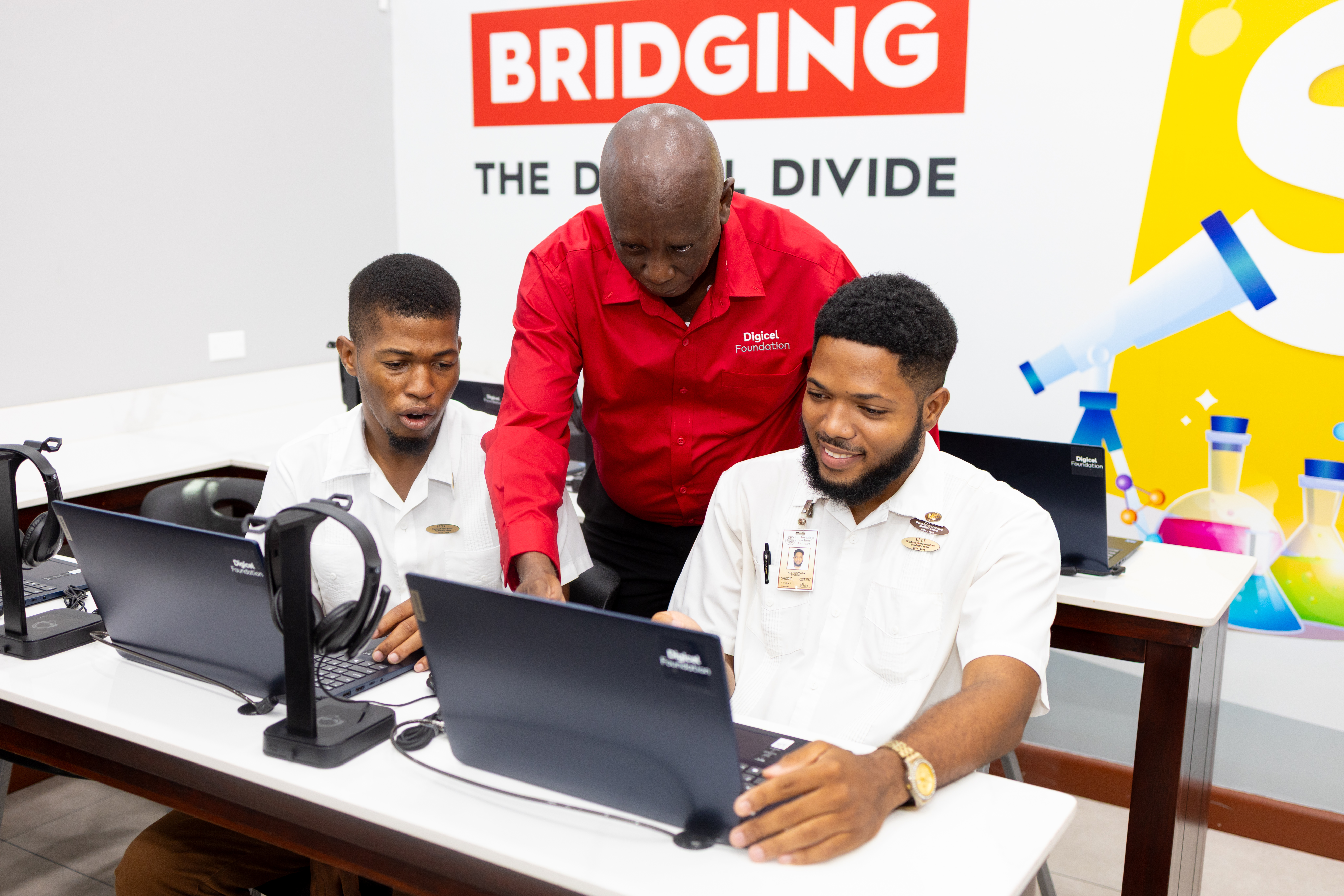
Digicel Foundation Board Director, Wayne Smith, engages with St. Joseph’s Teachers’ College Student Union President, Sariek Edwards (left), and Vice President, Alex Hepburn, inside the newly opened Smart Lab. The lab is the first of five being installed at teachers’ colleges across the island.
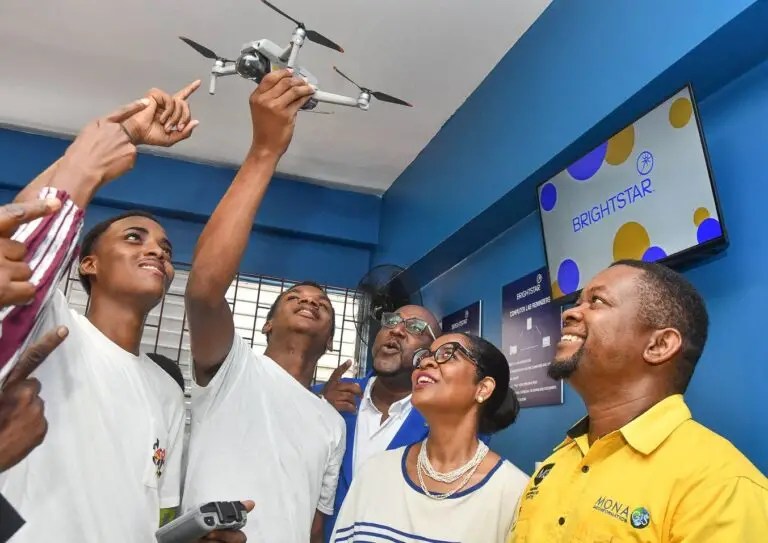
Trench Town youngsters Steve Lawrence (left) and Everton Levy enjoy their introduction to drone technology with Andrew Thomas (centre), senior telecom engineer at Brightstar, Debbie Green (second right), general manager Brightstar, and Luke Buchanan, executive director Mona GeoInformatics Institute.
A new chapter of technological innovation was unveiled in south St Andrew community of Trench Town on Tuesday as Brightstar Lottery Jamaica (BLJ) commissioned an after-school advantage centre, equipped to facilitate drone technology training for the youth in the area.
The handover ceremony, which was held at the Trench Town Community Development Committee (CDC), marked the company’s 15th donation of an after-school advantage centre and the beginning of its third annual drone technology workshop, an initiative aimed at equipping young people with hands-on experience in drone operations.
In the keynote address, general manager at BLJ Debbie Green pointed out how drone technology has been transforming the world and argued that this innovation was necessary to ensure that Jamaica’s youth are not left behind in the ever-changing nature of the technological world.
“Drone technology isn’t just some distant future. It is real, it is present, and it’s shaping industries right now. Drones are rewriting what is possible. The global drone market is projected to exceed US$100 billion within the next few years. The question is now: whether our young people will participate in this economy,” said Green.According to Green, she has high hopes for the possibilities of the centre and urged the youth in the community to make the most out of the opportunity they have been given.
“It’s not just about access to computers, it’s about access to emerging technologies while they’re still emerging. It’s about ensuring that our Caribbean youth aren’t merely consumers of innovation, but creators of it. To the students here today, you are part of a community that has always punched above its weight — that has always reached higher,” she said, as she underlined the Trench Town’s cultural significance as the hometown of musical legends Bob Marley, Peter Tosh, and several others.“That same creative audacity that placed Trench Town on the world map through music now positions you to put it on the map through technology. The opportunities before you are boundless. You are a part of a community that speaks boldness. Your actions here today require curiosity, courage, and commitment. This centre is your launch pad. These drones are your tools, but the altitude you reach, that’s for you to determine,” added Green.
In the meantime, Lascelles Page, who delivered the vote of thanks, said he was invigorated by Green’s words of inspiration.
Page told the Jamaica Observer he was excited to see innovation that can impact the youth in his community.
“I think it’s a great opportunity for youth to come and learn. The training is great especially with the computers being here too. So I’m really grateful for that, I love to see this because this is my hometown, I grew up here, you know? So seeing this is just… I really appreciate it,” said Page.
He added that his introduction to drone technology has now broadened his horizons and has given him new passions and dreams in terms of possible career routes.
With opportunity now at his fingertips, Page declared that he is determined to make the most of it.
“I feel like learning how to use and fly one of these drones will open up new career paths for me because, as I said, technology is the future. So there will be jobs, like at Grand Gala where they use the drones to do the lights, I think that’s great.
“Somebody has to be the one who controls all of those drones. So I feel like doing this will help me unlock that door to get into this field. It’s not something that I thought about before, so that’s why I think it’s a great opportunity for me,” said Page.
Lascelles Page delivering the vote of thanks as Brightstar Lottery Jamaica (BLJ) commissioned an after-school advantage centre, equipped to facilitate drone technology training for the youth in Trench Town.Debbie Green (left), general manger Brightstar Lottery Jamaica, and Zann Locke acting president, Trench Town Community Development Committee, share the moment following the ribbon cutting to signal the opening of an after-school advantage centre, equipped to facilitate drone technology training for the youth in Trench Town on Tuesday.
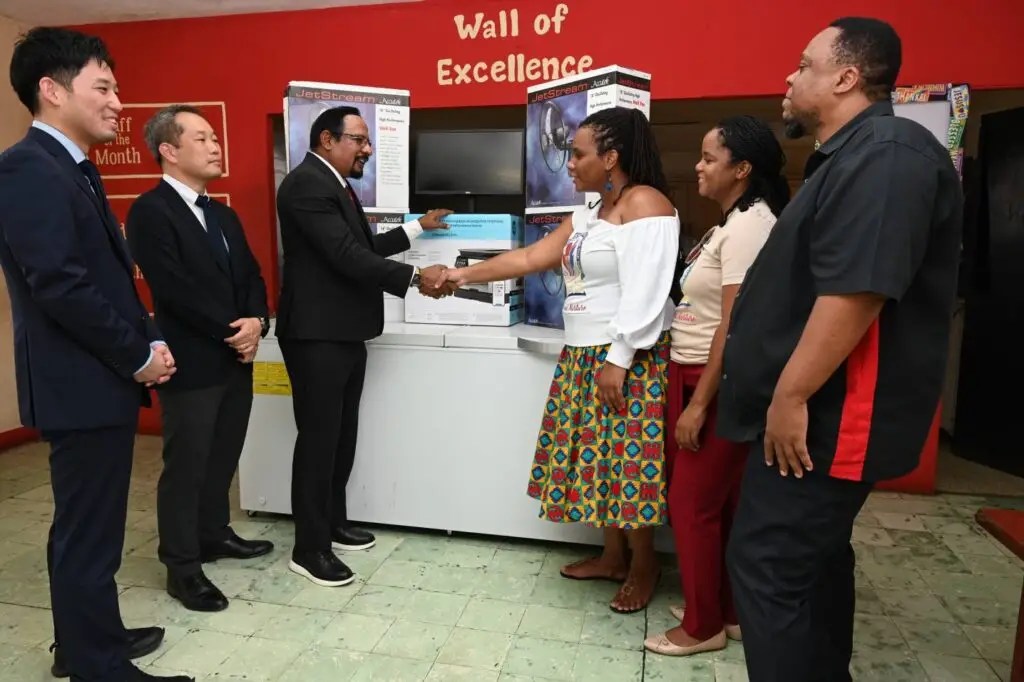
Managing director, Caribbean operations and chief operating officer of Marubeni Power International Mo Majeed (third left) shakes hands with Caribbean Christian Centre for the Deaf (CCCD) Principal Teri-Ann Bernard during the recent handover of items to the institution. Sharing the moment are (from left) Takuya Kokawa, associate, Marubeni Power International; Keisuke Harada, senior manager, Marubeni Power International; Trudy Powell, campus manager, CCCD Knockpatrick campus; and Owen-Rand Dowdie, campus manager, CCCD Kingston campus.
He may hold a prestigious position with Marubeni Power International, but Mo Majeed said occasions like his recent visit to the Cassia Park Avenue Campus of the Caribbean Christian Centre for the Deaf (CCCD), were his favourites. Majeed and his colleagues Damian Obiglio, Keisuke Harada and Takuya Kokawa have collaborated with various organisations including Food For the Poor, packing and distributing care packages and building a home for the needy in previous years.
Ajeed congratulated CCCD Principal Teri-Ann Bernard and staff for their significant contribution to the education of Jamaica’s deaf community. He said that his company is committed to supporting Jamaica’s most vulnerable learners and promoting accessible education. They donated $3.2 million for the purchase of computers, deep freezers, and wall fans to enhance learning opportunities and improve facilities for students who depend on specialised educational resources.
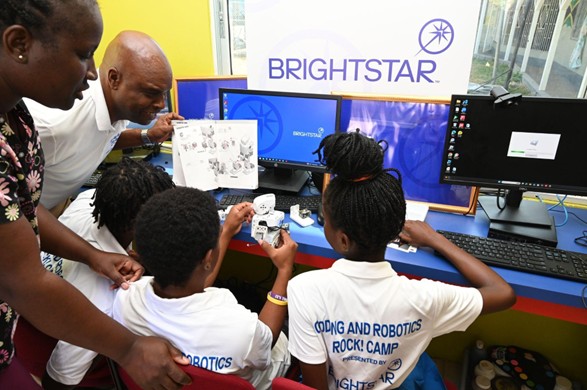
Students at the 2025 Brightstar Coding and Robotics Rock! Camp examine robotics components and reference materials under the guidance of staff volunteers and Centre Supervisors, developing technical skills through collaborative learning.
Brightstar Lottery (“Brightstar”), successfully completed its fifth annual Coding and Robotics Rock! Camp with 100 Caribbean students graduating from the programme. Comprised of students from five Caribbean territories – Jamaica, St. Kitts and Nevis, St. Maarten, Trinidad and Tobago and the US Virgin Islands – the Brightstar Coding and Robotics Rock! Camp proved that geography cannot limit Caribbean youth’s technological potential.
From July 14-25, students from Brightstar’s After School Advantage Centres immersed themselves in a cutting-edge curriculum developed with the Mona Geoinformatics Institute (“MGI”) at The University of the West Indies. Under the theme “Coding Opens Doors”, participants didn’t just learn technology – they became creators, innovators, and digital architects of the Caribbean’s technological future.
“The digital literacy gap isn’t merely a technological challenge; it’s a matter of economic sovereignty for Caribbean nations,” said Shelly Ann Hee Chung, Brightstar’s Director, Antilles. “Through our Coding & Robotics Rock! Camp, we cultivated a generation of innovative thinkers who transformed from technology consumers to creators, establishing a foundation for sustainable digital economies across our islands.”
The Coding and Robotics Rock! Camp featured two distinct learning tracks. Level 1 students mastered web development fundamentals, learning HTML for content creation, CSS for design, and JavaScript for interactivity. Their capstone projects included personalised websites featuring Home and About Me pages, Coding Careers pages exploring technology opportunities, Coding Tools pages highlighting development resources, and Contact Us pages – all inspired by the camp’s “Coding Opens Doors” theme.
Level 2 participants advanced into artificial intelligence (“AI”) and robotics, exploring AI applications, creating machine learning models using Google Teachable Machines, and building functional robots using VEX robotics platforms. Students engaged with cutting-edge technologies, including Robotic Process Automation and participated in VR.VEX virtual reality activities.
“In the rapidly evolving digital ecosystem, early exposure to computational thinking proves as fundamental as traditional literacy,” said Debbie Green, General Manager, Brightstar Jamaica. “Our multi-island approach to the Coding & Robotics Rock! Camp demonstrates our commitment to democratizing access to these critical skills, ensuring that geographical constraints don’t limit any child’s opportunity to participate in the digital future.”
The programme’s success was measured not only in technical skills acquired but in the transformation of student perspectives on technology careers. Participants discovered how coding opens doors to industries ranging from healthcare and finance to entertainment and environmental conservation, directly addressing the Caribbean’s need for homegrown technology talent.
Throughout the camp, students worked in virtual breakout rooms, fostering collaboration across territories while building individual expertise. The programme’s hands-on approach yielded extraordinary results. Students created working web calculators, interactive image carousels, and AI models addressing everything from hurricane preparedness to sustainable tourism. Their final presentations demonstrated not just technical proficiency but creative problem-solving that directly addressed Caribbean realities.
“By designing content that’s accessible to students regardless of their technical background, we are helping to cultivate the next generation of innovators who can use mapping, software engineering, data analysis, and geospatial thinking to solve real-world problems in their communities,” said Luke Buchanan, Executive Director, MGI.
The 2025 Brightstar Coding and Robotics Rock! Camp’s success arrives at a crucial moment. As Caribbean governments prioritise digital transformation and seek homegrown technology talent, Brightstar’s investment in youth development provides exactly the skilled workforce these ambitions require.
This fifth annual achievement positions Brightstar as more than a technology company – it’s a catalyst for Caribbean excellence, proving that strategic investment in youth education yields transformational results that can benefit entire regions for generations to come.
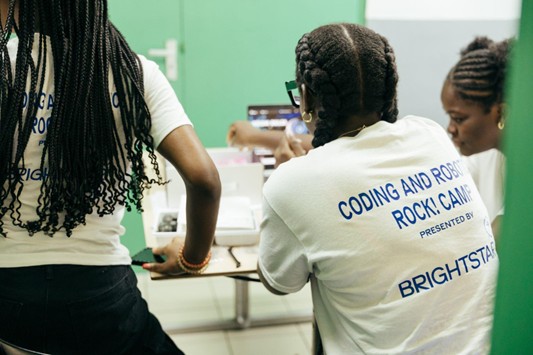
Students collaborate on coding projects during the 2025 Brightstar Coding and Robotics Rock!, developing essential digital skills via interactive technology education.
For decades, the Caribbean has watched its brightest talents migrate to the United States, Canada, and the United Kingdom, pursuing opportunities that seemed unattainable at home. However, a quiet revolution is unfolding across our islands, one that is transforming the story of Caribbean youth and their future prospects. Brightstar Lottery’s fifth annual Brightstar Coding & Robotics Rock! Camp, which took place from July 14 to 25, 2025, is more than just a technology education programme—it’s a strategic investment in increasing brain gain in our region.
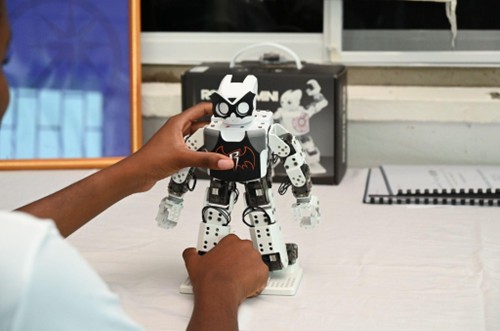
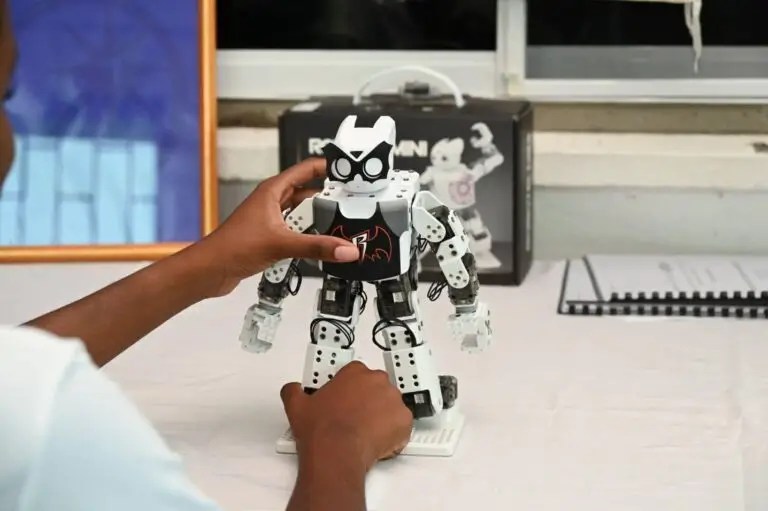
A student adjusts a humanoid robot during the fifth-annual Coding and Robotics Rock! Camp presented by Brightstar. The hands-on curriculum, developed in partnership with the Mona Geoinformatics Institute (MGI), is part of a STEM initiative aimed at fostering innovation and technological literacy among Jamaican youth
The concept of “brain gain” has become increasingly relevant as Caribbean nations recognise that retaining educated talent is crucial for sustainable development. Unlike traditional approaches that focus solely on economic incentives, Brightstar’s innovative camp tackles the root cause: the perception that meaningful technology careers do not exist in the Caribbean. “We’re not just teaching students to code; we’re showing them that the Caribbean can be a launchpad for global innovation,” explains Debbie Green, General Manager of Brightstar Jamaica. “When young people see that they can build cutting-edge robotics projects right here in Jamaica, work with international partners like the Mona Geoinformatics Institute, and collaborate with peers across the Caribbean, they begin to envision a future where staying home means staying ahead.”
This year’s camp brought together over 40 students from five Caribbean locations—Jamaica, St Kitts, St Maarten, Trinidad and Tobago, and the US Virgin Islands. The programme’s theme, “Coding Opens Doors,” took on greater significance when viewed through the lens of regional development. These doors do not only lead to individual opportunities; they open pathways to transforming entire economies.
The multi-island approach is especially crucial. Instead of creating isolated pockets of expertise, the programme fosters a connected network of young innovators who view themselves as part of a larger Caribbean tech ecosystem. This interconnectedness is essential for brain gain, as it shows that remaining in the Caribbean does not mean working in isolation. Amarez Huggins Delashley, from the camp’s 2024 cohort, notes: “The camp helped me to solve problems more easily: this made me think logically and solve complex problems. For example, solving a Rubik’s Cube, putting together a complex puzzle, etc. The Robotics Camp taught me multiple shortcuts, which are now helping me to easily access and use computers.” The economic implications are profound. Traditional Caribbean industries—tourism, agriculture, and financial services—are increasingly reliant on technology. Young people trained in coding and robotics are not
just prepared for hypothetical future jobs; they are enabled to innovate within existing industries and to develop entirely new ones.
“We’re witnessing the emergence of a generation that sees technology as a tool for Caribbean empowerment, not escape. These students are learning that they can build international-standard solutions while addressing uniquely Caribbean challenges. That’s the foundation of sustainable brain gain,” says Green. The camp’s collaboration with the Mona Geoinformatics Institute enhances academic rigour and local relevance in the curriculum. Students are not merely acquiring generic programming skills; they are investigating how technology can tackle Caribbean-specific issues, such as climate resilience, disaster preparedness, and sustainable tourism.
“Our partnership with Brightstar represents a critical shift in how we approach technology education in the Caribbean. By providing coding and robotics training in real Caribbean scenarios, from hurricane tracking, general software development and coastal monitoring to environmental stewardship, at MGI we help students see that some of the most exciting technological opportunities exist right here at home. These young innovators are not just learning to code; they are learning to build solutions for the Caribbean and beyond.”
Fun fact: students from other islands are already envisioning projects that could assist with oil spill clean-up—something that is very important for our environment here. The programme’s success is measured not only by the technical skills gained but also by the changed perspectives about the Caribbean’s potential. Participants leave with more than just coding knowledge; they carry a vision of the Caribbean as a place where innovation thrives and where young talent is nurtured.
The broader After School Advantage programme, which operates 38 centres across the English-speaking Caribbean, provides the infrastructure for this transformation. These centres ensure that the camp’s impact extends well beyond two weeks, establishing year-round communities of learning and innovation.
Programmes like Brightstar’s camp offer a path forward that does not require choosing between progress and place. By investing in technology education that is both world-class and locally relevant, Brightstar is not just training programmers—they are cultivating the architects of our region’s digital future. The true measure of success for initiatives like this will not be reflected in graduation statistics or job placement rates, but in the young Caribbean professionals who, in ten years’ time, will be leading technology companies, developing innovative solutions, and mentoring the next generation—all while calling the Caribbean home.
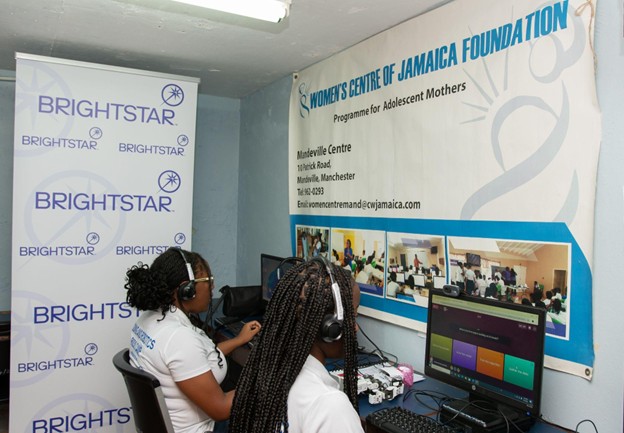
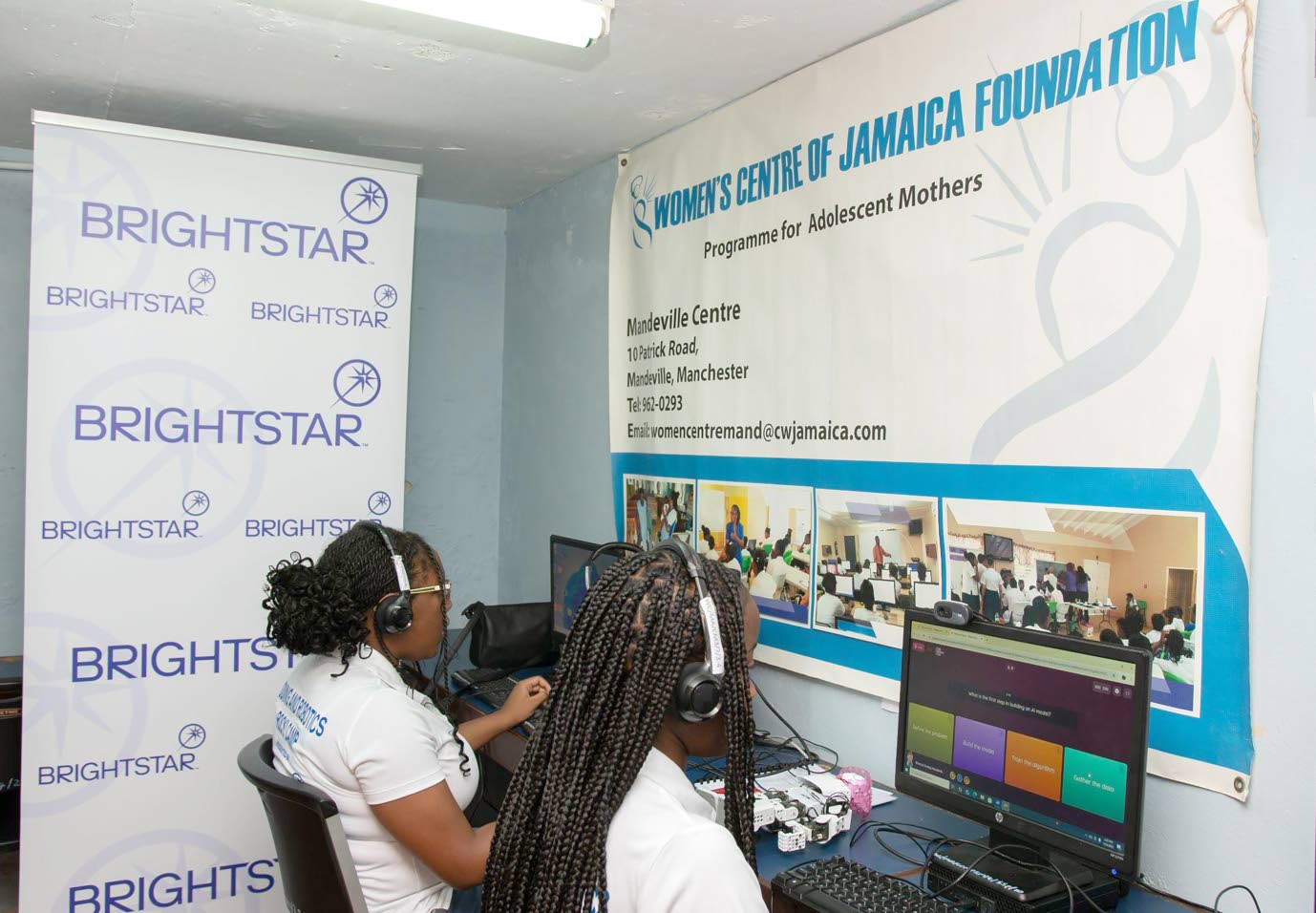
Students at the Women’s Centre of Jamaica Foundation’s Mandeville Centre participate in one of the Level II sessions during the 2025 Coding and Robotics Rock! Camp presented by Brightstar
Stephanie Lyew, Public Relations Account Executive for the Sean Paul Foundation presents graduation certificate to Bjorn Hawthorne, Senior Band Camp member with focus on the Keyboard. The graduation ceremony for the annual Band Camp was held on Thursday, August 21 on the grounds of Food For The Poor. The summer camp, which commenced on Monday, July 21, took in sixty students from St. Catherine and surrounding areas to develop their skills and talents in playing musical instruments.
The Food For The Poor (FFTP) annual Band Camp closing ceremony was held on Thursday, August 21, 2025 with rousing performances from the participants in the summer camp, held under the theme “Where Passion Meets Purpose: Saluting the Next Generation of Musicians”.
The camp, held on the grounds of FFTP in St.Catherine, brought together sixty talented youths from across the island, providing them with hands-on training in various musical disciplines including brass, percussion, woodwinds, and strings. Led by experienced music instructors, the four-week programme focused not only on technical ability but also on discipline, teamwork, and creative expression.
“The Band Camp is about more than learning to play an instrument,” said Camp Director Jeffrey Brown. “It’s about giving our youth a platform to grow, express themselves, and dream bigger; today’s performances are proof of what can happen when we invest in their potential.”
Over the course of the camp, students benefited from mentorship, instrument care workshops, and opportunities to collaborate on musical pieces. The initiative forms part of FFTP’s ongoing commitment to youth development, providing safe and inspiring spaces for creativity to thrive.
The closing ceremony featured graduates of the camp showcasing their achievements through stirring ensemble performances and vibrant renditions.
Andrew Mahfood, Chairman of Food For The Poor Jamaica remarked, “The Band Camp stands as a testament to the power of nurturing talent. The musical excellence on display is exceptional and it reflects the hard work of the students and mentors. This initiative goes beyond music; it is helping to build character and create brighter futures for our youth.”
The organisation is marking its 15th year of the camp and has influenced many of their students to establish their own music classes as a source of income.
FFTP Jamaica expresses gratitude to the sponsors: dancehall artiste Sean Paul and prominent goods production company, Wisynco; camp volunteers; and families whose support made the Band Camp a success.
Jamilia Crooks-Brown, Digicel Foundation’s Special Needs and Education Programme Manager (right), shows Leo, a student at St. Christopher’s School for the Deaf, and his mother, Karen Murphy, some of the items in his new backpack, courtesy of the Foundation. Watching with joy is Natalee Walker (left), the school’s guidance counsellor
As the new school year approaches, the Digicel Foundation is helping to ensure that students with special needs head back to the classroom equipped and empowered. The Foundation visited three special needs institutions to hand over back-to-school supplies as part of its ongoing commitment to inclusive education. The schools visited include the Salvation Army School for the Blind in Kingston, Catherine Hall Primary Special Education Unit in St. James, and St. Christopher’s School for the Deaf in St. Ann.
Each school received essential school supplies such as backpacks, writing tools, notebooks, and other learning materials tailored to meet the needs of students living with disabilities. “Every child deserves a fair start, and for students with special needs, access to the right resources can make a world of difference,” said Jamilia Crooks-Brown, Special Needs and Education Programme Manager at the Digicel Foundation. “The visits are part of the Foundation’s wider back-to-school outreach, aligned with its core mission to create a world where no one gets left behind.”
Since 2004, the Digicel Foundation has invested over US$12.09 million in special needs and has built or renovated 21 special needs schools, trained over 390 teachers, parents, and caregivers, and impacted more than 170,000 lives. “We are especially proud to stand with our special needs community as the new school year begins,” added Crooks-Brown. “We’ll continue to advocate for inclusive education, invest in accessible learning spaces, and celebrate the potential in every child.”
How coding initiatives encourage educated youth to stay local
A student adjusts a humanoid robot during the fifth annual Coding and Robotics Rock! Camp presented by Brightstar. The hands-on curriculum, developed in partnership with the Mona Geoinformatics Institute, is part of a STEM initiative aimed at fostering innovation and technological literacy among Jamaican youth.
FOR decades, the Caribbean has watched its brightest talents migrate to the United States, Canada, and the United Kingdom, pursuing opportunities that seemed unattainable at home. However, a quiet revolution is unfolding across our islands, one that is transforming the story of Caribbean youth and their future prospects.
Brightstar Lottery’s fifth annual Brightstar Coding & Robotics Rock! Camp, which took place from July 14 to 25, 2025, is more than just a technology education programme — it’s a strategic investment in increasing brain gain in our region.The concept of “brain gain” has become increasingly relevant as Caribbean nations recognise that retaining educated talent is crucial for sustainable development. Unlike traditional approaches that focus solely on economic incentives, Brightstar’s innovative camp tackles the root cause: the perception that meaningful technology careers do not exist in the Caribbean.
“We’re not just teaching students to code — we’re showing them that the Caribbean can be a launchpad for global innovation,” explains Debbie Green, general manager of Brightstar Jamaica. “When young people see that they can build cutting edge robotics projects right here in Jamaica, work with international partners like the Mona Geoinformatics Institute, and collaborate with peers across the Caribbean, they begin to envision a future where staying home means staying ahead.”This year’s camp brought together over 40 students from five Caribbean locations — Jamaica, St Kitts, St Maarten, Trinidad and Tobago, and the US Virgin Islands. The programme’s theme, ‘Coding Opens Doors’, took on greater significance when viewed through the lens of regional development. These doors do not only lead to individual opportunities — they open pathways to transforming entire economies.
The multi-island approach is especially crucial. Instead of creating isolated pockets of expertise, the programme fosters a connected network of young innovators who view themselves as part of a larger Caribbean tech ecosystem. This interconnectedness is essential for brain gain as it shows that remaining in the Caribbean does not mean working in isolation.Amarez Huggins Delashley, from the camp’s 2024 cohort, notes, “The camp helped me to solve problems more easily; this made me think logically and solve complex problems. For example, solving a Rubik’s cube, putting together a complex puzzle, etc, the robotics camp taught me multiple shortcuts which are now helping me to easily access and use computers.”
The economic implications are profound. Traditional Caribbean industries — tourism, agriculture, and financial services — are increasingly reliant on technology. Young people trained in coding and robotics are not just prepared for hypothetical future jobs, they are enabled to innovate within existing industries and to develop entirely new ones.“We’re witnessing the emergence of a generation that sees technology as a tool for Caribbean empowerment, not escape. These students are learning that they can build international-standard solutions while addressing uniquely Caribbean challenges. That’s the foundation of sustainable brain gain,” says Green.
The camp’s collaboration with the Mona Geoinformatics Institute enhances academic rigour and local relevance in the curriculum. Students are not merely acquiring generic programming skills, they are investigating how technology can tackle Caribbean-specific issues such as climate resilience, disaster preparedness, and sustainable tourism.
“Our partnership with Brightstar represents a critical shift in how we approach technology education in the Caribbean. By providing coding and robotics training in real Caribbean scenarios — from hurricane tracking, general software development and coastal monitoring to environmental stewardship — at MGI we help students see that some of the most exciting technological opportunities exist right here at home. These young innovators are not just learning to code, they are learning to build solutions for the Caribbean and beyond.”
Fun fact: Students from other islands are already envisioning projects that could assist with oil spill clean-up — something that is very important for our environment here.The programme’s success is measured not only by the technical skills gained but also by the changed perspectives about the Caribbean’s potential. Participants leave with more than just coding knowledge, they carry a vision of the Caribbean as a place where innovation thrives and where young talent is nurtured.
The broader After School Advantage programme, which operates 38 centres across the English-speaking Caribbean, provides the infrastructure for this transformation. These centres ensure that the camp’s impact extends well beyond two weeks, establishing year-round communities of learning and innovation.
Programmes like Brightstar’s camp offer a path forward that does not require choosing between progress and place. By investing in technology education that is both world-class and locally relevant, Brightstar is not just training programmers — they are cultivating the architects of our region’s digital future.
The true measure of success for initiatives like this will not be reflected in graduation statistics or job placement rates, but in the young Caribbean professionals who, in 10 years’ time, will be leading technology companies, developing innovative solutions, and mentoring the next generation — all while calling the Caribbean home.
Students at the Women’s Centre of Jamaica Foundation’s Mandeville branch participate in one of the level II sessions during the 2025 Coding and Robotics Rock! Camp presented by Brightstar..







 Jamaica Highlights